



Medvedev’s Warning and Pashinyan’s Perilous Pivot
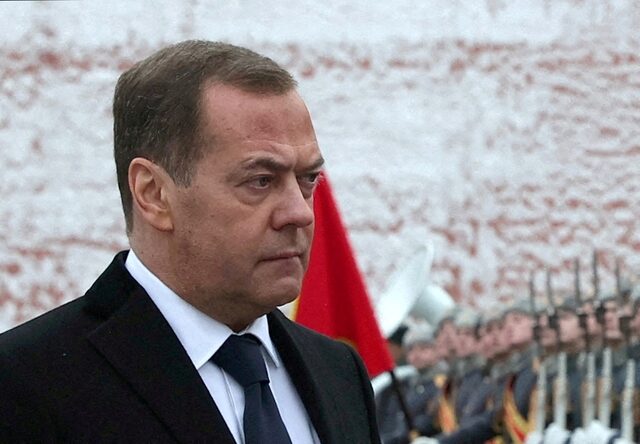

“What is particularly dangerous is that the temporary occupant Nikol is actively pushing his homeland down the sorrowful path of Banderite Ukraine,” the Deputy Chairman of Russia’s Security Council and former Russian President Dmitry Medvedev told RIA Novosti on May 25.
The phrase “temporary occupant” – a deliberate denial of legitimacy to a sitting prime minister – landed in Yerevan like a slap less than two weeks before Armenians head to the polls on June 7.
Medvedev was just getting started. Pashinyan, he said, had “failed to appreciate the numerous examples of fraternal assistance and support from Moscow and has chosen a course toward severing relations with Russia.” The prime minister had “put relations with Russia, the CSTO and the EAEU under direct threat” – and “this will not go without consequences for him and his people, including, of course, the economic parameters of cooperation.”
Russia has spent the past month methodically demonstrating what those consequences look like. Its agricultural watchdog Rosselkhoznadzor has banned Armenian flower imports outright, citing phytosanitary concerns – 135 cases flagged out of 96.2 million blooms. Armenia supplies roughly 10% of Russia’s cut tulips, and its roses retail for up to 60% less than Ecuadorian imports. That market is now closed. Rospotrebnadzor, the consumer protection agency, has suspended sales of Armenian wine, cognac, and the Jermuk mineral water brand – more than 1.3 million bottles pulled from Russian shelves. Inspectors are now examining Armenian vegetables and fruits. It’s only a matter of time until the economic pain translates into political pressure.
These trade restrictions accelerated immediately after Yerevan hosted the European Political Community summit in early May – an event attended by Ukrainian President Volodymyr Zelenskyy, who used the platform to warn that Ukrainian drones could fly over Moscow during the May 9 Victory Day parade. Russia’s Foreign Ministry summoned Armenia’s ambassador to denounce what it called “terrorist threats” made from Armenian soil. Medvedev made certain to mention this too: Pashinyan, he said, “is gathering vile enemies of Russia in Yerevan.”
This is the punitive backdrop against which Pashinyan must now campaign. The prime minister has responded by insisting, on May 22, that “Armenia has never been and never will be involved in anti-Russian actions and will not be hostile to Russia.” He denies hostility but does not retreat from the European pivot that triggered it. The contradiction is becoming unsustainable.
Pashinyan will not even attend the EAEU summit in Astana on May 29, sending Deputy Prime Minister Mher Grigoryan in his place. Russia’s Foreign Ministry spokeswoman Maria Zakharova noted that his absence from such gatherings “has become systemic.” The Kremlin is now threatening to raise Armenia’s continued EAEU membership at that very summit – a move that could formally begin the process of economic disentanglement.
Behind the regulations sits a more fundamental pressure point: energy. Russian President Vladimir Putin recently pointed out that Armenia receives natural gas at roughly 177.50 per thousand cubicmetres – a fraction of the more than 600 that European buyers pay. Deputy Prime Minister Alexei Overchuk warned that closer alignment with Brussels would mean “customs duties will arise, gas prices will change, and so will energy prices.” Medvedev has previously advised Pashinyan to begin negotiating American LNG supplies now, because the benefits of EAEU membership – cheap energy chief among them – will evaporate the moment Yerevan’s geopolitical tilt becomes irreversible.
Pashinyan has tried to frame gas pricing as a technical matter governed by long-term contracts. That is either naive or disingenuous. In the post-Soviet space, energy pricing has never been merely technical. Putin’s willingness to wield this geopolitical instrument is well documented. Ukraine learned this in 2006 and 2009. Moldova learned it repeatedly.
The current crisis did not emerge from nowhere. Relations between Moscow and Yerevan have unraveled steadily since Azerbaijan’s 2023 military operation recaptured Nagorno-Karabakh. Armenia had been Russia’s closest ally in the South Caucasus – hosting a Russian military base, depending on the Kremlin for weapons, and integrating deeply into Moscow-led institutions.
Pashinyan accelerated toward the West: a law initiating the EU accession process passed parliament, cooperation with NATO deepened, and the US-brokered TRIPP corridor agreement signed in Washington signaled a strategic realignment away from Moscow. This is the context for Medvedev’s “Bandera Ukraine” accusation – and for Foreign Minister Sergey Lavrov‘s parallel warning that “the West is trying to do in Armenia what it did in Georgia, Moldova, and Ukraine.”
From Moscow’s perspective, a post-Soviet state begins with EU association, moves toward NATO cooperation, and ends up as a platform for Western military infrastructure. Whether or not that is Pashinyan’s actual intention, the Kremlin has clearly decided to treat it as such.
With the June 7 parliamentary election days away, Pashinyan’s Civil Contract party leads polling at roughly 25.1%, with a fragmented opposition trailing dangerously close behind.
So what is his economic agenda? Walking away from the EAEU means losing tariff-free access to Russia’s market, which absorbs roughly 38% of Armenian exports. Walking away from Russian gas means facing European energy prices that Armenian households and businesses cannot afford. The EU can offer credit, technical assistance, and long-term investment – but it cannot replace subsidized gas or absorb Armenian agricultural exports on short notice. The gap between the strategic ambition and the economic arithmetic is wide and widening.
Putin has already offered a characteristically ominous framing:
“How did it start? It started with Ukraine’s joining or attempting to join the EU.”
The path Armenia is on has been traveled before, and Moscow’s tolerance for such journeys is exhausted.
Whether Pashinyan remains in office for years or weeks, the economic architecture that sustained Armenia for three decades is being dismantled in real time. The prime minister has wagered that Europe will fill the void before the bill comes due. Given the pace at which Brussels moves and the speed at which Moscow punishes, that is a bet of extraordinary recklessness – or extraordinary faith. The voters of Armenia will deliver their verdict on June 7. The Kremlin, it seems, has already delivered its own.


The latest news in your social feeds
Subscribe to our social media platforms to stay tuned