
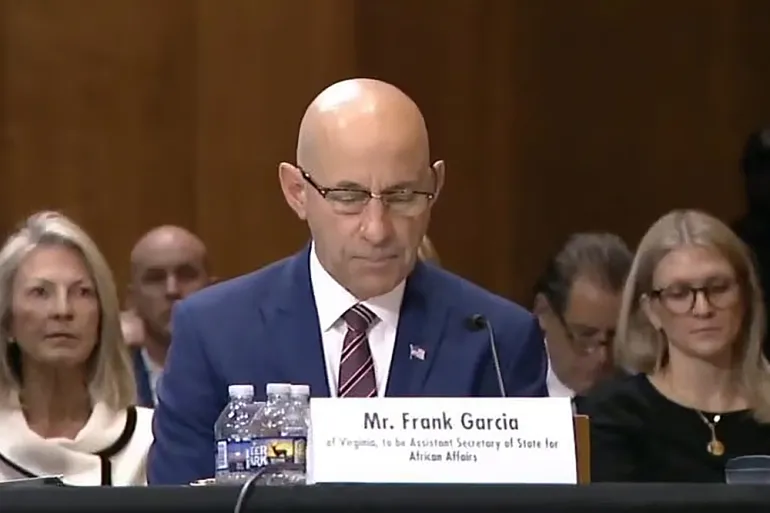


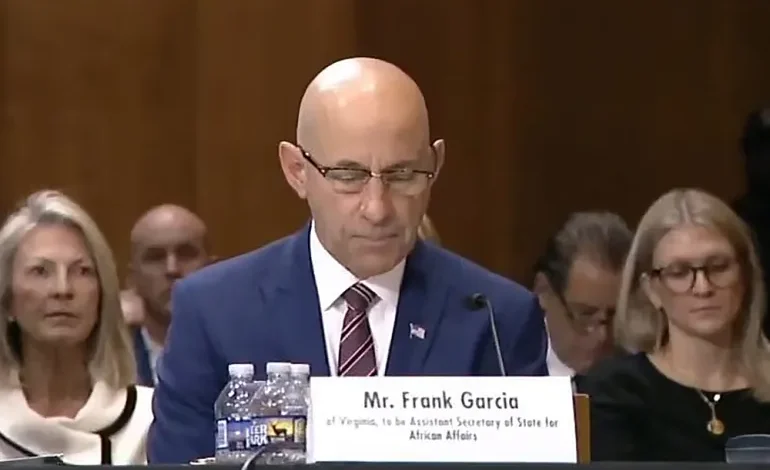

The US Senate has confirmed veteran naval officer Frank Garcia as Washington’s top diplomat for Africa, ending a vacancy that had lasted for more than a year and underscoring how the Trump administration is reframing its priorities on the continent.
Garcia’s approval came this week as part of a larger Senate vote confirming 49 Trump administration nominees. The role he now takes over — Assistant Secretary of State for African Affairs — is the most senior US diplomatic post focused on Africa, overseeing relations with all 54 countries on the continent.
Until now, the position had been filled by acting officials, most recently former CIA analyst Nick Shikher.
Garcia arrives with a background rooted far more in defence and intelligence than in traditional diplomacy. A former US Navy officer, he served for 28 years and later spent roughly 15 years working with the House Intelligence Committee on African affairs. He also served as chief of staff at the National Reconnaissance Office, the agency responsible for US intelligence satellites.
Between 2016 and 2021, Garcia headed the defence and intelligence consultancy Via Stelle, according to The Africa Report.
Still, his appointment has drawn some skepticism from parts of the African policy world. Nigerian newspaper The Whistler described him as relatively unknown in academic and diplomatic circles focused on Africa, pointing out that he has little published work on the region.
The Senate Foreign Relations Committee approved his nomination in March by a 16-6 vote, with Democrats initially providing all opposition. But several Democrats later backed his final confirmation in the full Senate.
Garcia takes office at a moment when Africa is increasingly viewed in Washington less through the lens of development policy and more through geopolitical competition — especially over critical minerals, infrastructure and Chinese influence.
That shift was visible during Garcia’s confirmation hearing on March 5, where he argued that previous US policy relied too heavily on aid-driven relationships.
He said past approaches often created dependency and were “focused on spreading divisive ideologies”.
Instead, Garcia outlined a strategy centered on “trade and investment for mutual benefit,” closely aligned with the Trump administration’s broader “America First” framework.
The message reflects a larger transformation underway in US foreign policy toward Africa. Humanitarian assistance and democracy promotion remain part of the official agenda, but economic competition and supply-chain security are increasingly taking priority.
Garcia pointed specifically to the Lobito Corridor as an example of that new approach.
The corridor is a major rail and transport project stretching roughly 1,300km from Angola’s Atlantic port of Lobito into the mineral-rich regions of the Democratic Republic of the Congo and Zambia. The route is designed to speed up exports of copper, cobalt and other strategic minerals essential for electric vehicles and clean-energy technologies.
For Washington and its European allies, the project is not just about infrastructure. It is also about reducing dependence on Chinese-controlled supply chains and securing alternative access to the raw materials driving the global energy transition.
China already maintains deep influence across African mining and infrastructure sectors, particularly in Central and Southern Africa. That has turned projects like the Lobito Corridor into part of a wider strategic contest over resources, transport routes and political influence.
Garcia framed the corridor as a model capable of linking regional integration with economic opportunity and job creation.
At the same time, he made clear that all forms of US spending in Africa — including humanitarian and health programmes — would increasingly be evaluated through the lens of national security and economic return.
For supporters of the project, the corridor could help improve regional trade and infrastructure while creating leverage for countries like Angola, Zambia and the DRC as global demand for critical minerals rises.
Critics, however, argue that many such projects still risk functioning primarily as extraction routes serving external powers rather than transforming local economies.


The latest news in your social feeds
Subscribe to our social media platforms to stay tuned