





Mystery of Little Soda Lake’s Blood-Red Hue Baffles Experts
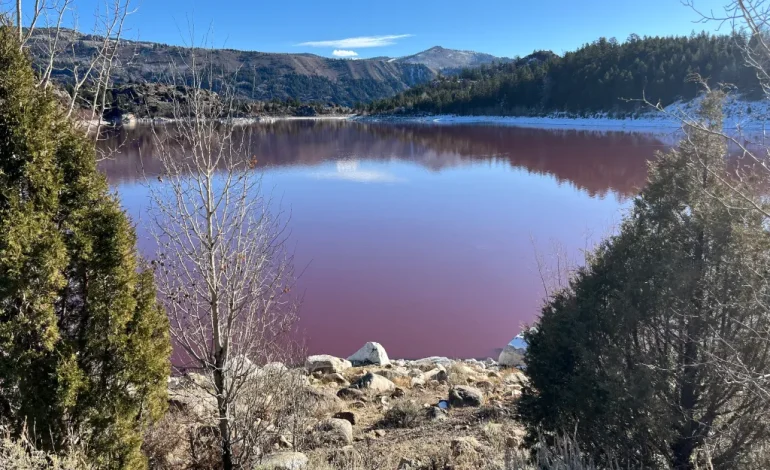

Once a Beloved Fishing Spot, the Lake’s Unusual Color Shift Sparks Investigation by State and Federal Authorities, Wyo File reports.
Little Soda Lake, a scenic 50-acre waterbody just north of Pinedale, Wyoming, has become the focus of an ongoing environmental investigation after its waters mysteriously turned a deep, blood-red hue. Once a popular fishing destination stocked with rainbow trout, the lake is now off-limits for swimmers, pets, and anglers as state and federal agencies work to determine the cause of the dramatic change.
The Wyoming Department of Environmental Quality (DEQ) issued a warning this fall about a harmful cyanobacteria bloom at the lake. However, unlike the more typical “blue-green algae” seen in other Wyoming lakes, Little Soda Lake’s bloom took on an unusual reddish appearance.
“It’s possible that the reddish color may be related to some other bacteria,” said Eric Hargett, water quality standards program supervisor for the Wyoming DEQ.
The first signs of trouble at Little Soda Lake appeared in early 2023. When Pete Cavalli, a fisheries biologist with the Wyoming Game and Fish Department, visited the lake to assess conditions for the spring trout stocking, he noticed something unusual. The water, while still cold, appeared greener than normal, and the shorelines were littered with cattle manure.
“The smell was overwhelming,” Cavalli said.
As a result, Game and Fish officials decided not to stock the lake with trout, a decision that would remain in place for two consecutive years.
By November 2024, a local hunter reported that the lake’s water had turned a striking red, prompting further investigation. Jill McMurray, a Bridger-Teton National Forest staffer responsible for water quality sampling, began collaborating with Game and Fish and other agencies to determine what was happening.
“We don’t have enough information yet,” McMurray said. “Eucapsis, the main cyanobacteria species that the state identified in the sample, can turn red.”
Several possible explanations for the lake’s color shift are under consideration.
- Cyanobacteria Bloom
- Cyanobacteria, often called “blue-green algae,” are known to bloom under certain conditions. The specific strain identified in Little Soda Lake, Eucapsis, typically appears green or bluish-green, but it can sometimes turn red.
- While cyanobacteria are a natural part of aquatic ecosystems, harmful blooms can release toxins that make the water unsafe for humans and animals.
- Organic Matter and Seasonal “Turnover”
- McMurray suggested that the lake’s “turnover” — when colder, oxygen-depleted water at the bottom of the lake mixes with the surface water — might have played a role. The dying organic material may have triggered the red coloration, much like how autumn leaves turn red.
- This explanation would be consistent with seasonal changes, though it doesn’t fully account for the water’s persistent red tint, which continues even as temperatures have dropped.
- Bacteria or Other Unknown Contaminants
- While Eucapsis cyanobacteria has been linked to the color change, Hargett said it’s possible that another type of bacteria could be responsible.
“In Wyoming, we typically do not see cyanobacteria blooms display in reddish colors,” he said.
- Impact of Cattle Grazing
- The presence of cattle around the lake has drawn speculation from locals. Over the summer of 2024, the lake’s shoreline was visibly covered with cattle tracks and manure, which could have contributed to nutrient runoff and fueled the bloom.
- While cattle have been linked to harmful algae blooms in other areas, McMurray noted that other backcountry lakes with no grazing activity — such as V Lake, Twin Lakes, and Meeks Lake near Big Sandy Opening — have also experienced cyanobacteria blooms.
Long-term drought conditions in the Green River Basin are also believed to be a contributing factor. Cavalli noted that the region’s water levels have been steadily declining in recent years. While Soda Lake — Little Soda’s larger neighbor — has dropped by about 15 feet from its historic high point, Little Soda Lake’s water level has fallen by 6 to 8 feet.
“All the evidence points to the fact that we’ve been in the long-term drought,” Cavalli said. “We’re not getting the moisture that we used to get, and [Soda Lake] is going down every year.”
Drought can reduce water volume, concentrate nutrients, and change water chemistry, all of which create favorable conditions for harmful cyanobacteria blooms.
The most immediate impact of the environmental shift at Little Soda Lake is the loss of its status as a recreational fishery. For years, the lake was a popular fishing destination for anglers hoping to catch rainbow trout. But with no trout stocked in 2023 or 2024 — and with conditions still deteriorating — the lake has been declared a “non-fishery.”
“It was a pretty popular fishery, especially among Soda Lake anglers,” Cavalli said.
Soda Lake, once home to as many as 47,000 trout, has also seen a drastic decline in fish populations. Now, it is estimated to hold fewer than 1,000 trout most years. Cavalli attributes the decline to lower water levels, poor oxygenation, and the cumulative effects of climate change.
State and federal agencies plan to continue monitoring Little Soda Lake in 2024 and beyond. The Wyoming DEQ is set to test for levels of nitrogen, phosphorus, nitrate, ammonium, and phosphate — all of which can contribute to harmful cyanobacteria blooms. They will also analyze for potential cyanotoxins that could pose health risks.
McMurray, who works with the Bridger-Teton National Forest, plans to assist in next summer’s sampling. She noted that the complexity of environmental changes makes it unlikely that any single factor is to blame.
“It’s not just one thing that’s causing this problem,” McMurray said. “The biggest thing is probably climate change and the change in the water table. And then there are other variables probably exacerbating this issue.”
Even after the lake froze over, the red hue remained visible beneath the ice. Photos taken during a Game and Fish aerial wildlife survey on December 4, 2024, show that the eerie, blood-red tint persists.
Cavalli had initially hoped that winter temperatures would kill off the cyanobacteria and clear up the water. But as of now, the mystery remains unsolved.
“I thought when the temperatures dropped, the cyanobacteria would die back and it would clear up,” Cavalli said. “But obviously, it’s still happening — whatever it is.”



The latest news in your social feeds
Subscribe to our social media platforms to stay tuned