





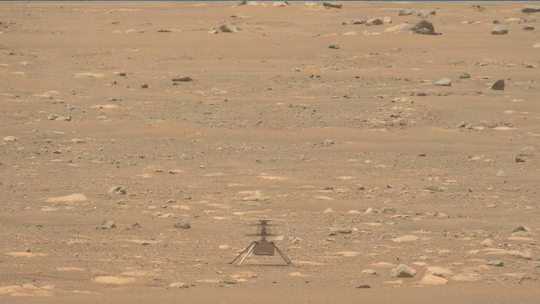

NASA has completed its first-ever crash investigation of an aircraft on another planet, shedding light on the events that led to the crash of the Ingenuity helicopter on Mars, the Washington Post reports.
The four-pound drone, which made history as the first powered, controlled flight on another world, crashed during its 72nd flight after encountering navigation issues caused by Mars’ featureless terrain. Despite the setback, Ingenuity remains operational, continuing to send back valuable data from the Martian surface.
According to NASA, Ingenuity’s crash was a result of its navigation system struggling to track its location over a bland, unmarked stretch of the Martian surface. The incident occurred on January 18, 2023, during what was supposed to be a short flight. The helicopter rose to a height of 40 feet, hovered for 4.5 seconds, and then began to descend.
However, the descent did not go as planned. Ingenuity struck the slope of a sand ripple with significant lateral velocity, which caused a portion of its rotor blade to break off and land about 49 feet away.
NASA’s investigation initially suggested that the rotor blades may have struck the ground directly. However, engineers concluded that the damage was caused by “bending loads” during the hard landing. The failure point on each rotor blade was located about halfway between the blade’s root and its tip.
“What happened here is, any piece of hardware if you push it hard enough beyond its design limits, sooner or later it’s going to break,” said Havard Grip, an engineer at NASA’s Jet Propulsion Laboratory (JPL) who was involved in the investigation. “We simply found out where Ingenuity’s limits were.”
Ingenuity was designed as a technology demonstration to test if a helicopter could fly in Mars’ thin atmosphere, which has only 1% of the density of Earth’s. It was originally scheduled for just five flights over 30 Martian days but far exceeded expectations. Since its arrival on Mars in early 2021, Ingenuity has completed 71 successful flights and traveled over 10 miles across the Martian surface.
The helicopter launched from the undercarriage of the Perseverance rover, and its first flight in April 2021 was celebrated as a “Wright Brothers moment” for interplanetary exploration. From then on, Ingenuity served as a scouting tool for Perseverance, helping it navigate the terrain and identify areas of scientific interest.
But as the mission’s scope expanded, Ingenuity was pushed beyond its initial design limits.
“We pushed her further, higher, faster than anything we had intended to do,” said Travis Brown, an engineer at JPL.
In the flights leading up to the crash, Ingenuity had already begun to show signs of navigation difficulty. During its 70th flight, the helicopter struggled to orient itself over a featureless landscape. On its 71st flight, those issues escalated, and it executed an emergency landing.
NASA believes that this hard landing on Flight 71 may have caused some internal damage, which ultimately affected Flight 72. However, because the incident occurred over 100 million miles away, NASA had no direct means to inspect the helicopter.
“There’s no black box. There’s no eyewitnesses. We can’t walk up and touch anything,” said Grip.
Although Ingenuity is no longer flying, it is not considered “dead.” The helicopter is still capable of transmitting data and has been repurposed as a weather station on Mars. Its sensors continue to provide valuable atmospheric information, helping inform future missions and the continued operations of the Perseverance rover.
Ingenuity’s achievements have been widely recognized as a landmark in space exploration. No other rotor-powered aircraft has flown on another world, and the data gathered from its flights has set the stage for future exploration concepts. NASA’s Dragonfly mission to Saturn’s moon Titan, for instance, will apply lessons learned from Ingenuity’s flights on Mars.
While Flight 72 marked a dramatic conclusion to the helicopter’s ability to fly, NASA sees it as a valuable learning experience. The mission revealed the helicopter’s performance limits and demonstrated how much farther NASA could push the limits of extraterrestrial aviation.



The latest news in your social feeds
Subscribe to our social media platforms to stay tuned