




Wyoming lawmakers have advanced two bills aimed at reforming the state’s approach to gambling regulations, Casper Star-Tribune reports.
The proposed measures, which will be considered in the 2025 general session, would grant city and town governments more control over the approval of historic horse racing (HHR) machines and authorize interstate betting on Wyoming horse races.
The bills are part of a broader review of Wyoming’s billion-dollar gambling industry, which has rapidly expanded since the legalization of new gaming forms three years ago. Lawmakers are now working to address regulatory gaps.
A bill titled “Local approval for simulcasting” would give town and city governments the authority to approve or deny permits for HHR machines within their jurisdictions. Under current law, these decisions rest solely with county commissioners.
The proposal is the result of a compromise between city and county officials. Under the bill, if a permit is sought for an HHR machine within city limits, approval would be required from both the city government and the county commission. If the machine is located outside city limits, only the county commission’s approval would be necessary.
This “asymmetry” drew criticism from Rep. Clark Stith (R-Rock Springs), who argued that the process was inconsistent.
“If the machines are in a city, then you have to have the approval of both the city council and the county commissioners. But if these machines are located in the unincorporated areas of the county outside the city limits, then you just need the county commission,” he said. “The city has no say. That’s just weird.”
Jerimiah Rieman, executive director of the Wyoming County Commissioners Association, argued that counties should maintain a role in the process, noting that counties are responsible for services related to gambling, such as law enforcement, prosecution, and mental health services.
Supporters of the measure, including Cheyenne City Councilman Mark Rinne, say local governments need greater control over gaming sites that directly affect their communities.
“The only gaming sites the city is concerned with are ones within city limits because it does have an impact on our neighborhoods,” Rinne said.
The bill was approved by the Joint Appropriations Committee (JAC) and will be taken up during the 2025 general session.
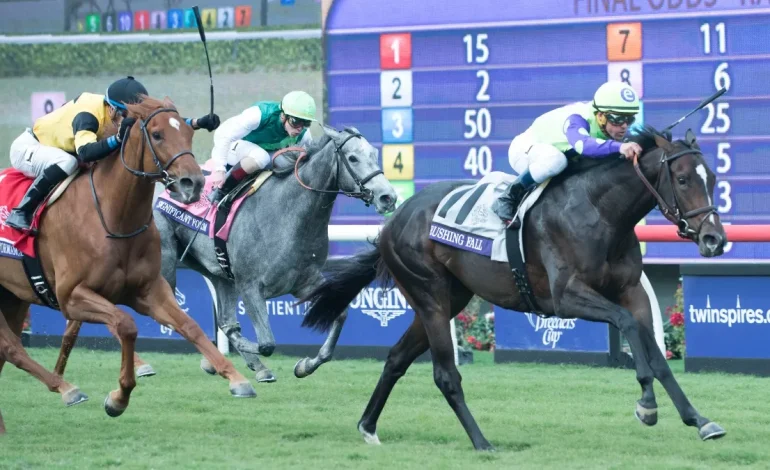
A second measure, titled “Interstate export of Wyoming horseracing”, would allow Wyoming-based thoroughbred horse races to be broadcast nationally for betting under the Horseracing Integrity and Safety Act (HISA), a federal law passed in 2020 to regulate horse racing safety and anti-doping measures.
Currently, Wyoming horse races are regulated by the Wyoming Gaming Commission, but under the new bill, they would become HISA-compliant, enabling wagering from bettors nationwide.
The bill proposes a 6% tax on net proceeds from interstate wagering, which would be paid into Wyoming’s general fund. This tax would be in addition to an existing 1% pari-mutuel wagering fee. Rep. Tom Walters (R-Casper), who has led efforts to study state gaming regulations, explained that the new tax would only apply to revenue from out-of-state wagering.
“Tracks (around the country) are closing, and so Wyoming’s horse racing industry is growing,” Walters said. “That’s where we can grow the state, the activity, outside of our borders.”
However, the bill has drawn opposition from some industry stakeholders. Neal Tomlinson, a spokesperson for Wyoming Downs, argued that the legislation is premature, citing ongoing litigation before the US Supreme Court regarding the constitutionality of HISA.
Tomlinson claimed that compliance with HISA would cost Wyoming Downs nearly $1 million. The Wyoming Gaming Commission’s Deputy Director Nick Larramendy stated that it has cost the state roughly $160,000 to make its four operational tracks HISA-compliant, with each track paying about $40,000.
Despite concerns, the JAC voted to advance the bill to the 2025 general session. The outcome of the Supreme Court litigation could affect how the state and operators move forward.
Both bills are set to be discussed during Wyoming’s 2025 general session, which begins on January 14.


The latest news in your social feeds
Subscribe to our social media platforms to stay tuned