





ESA Launches Proba-3: Creating Artificial Solar Eclipses to Unlock Sun’s Secrets
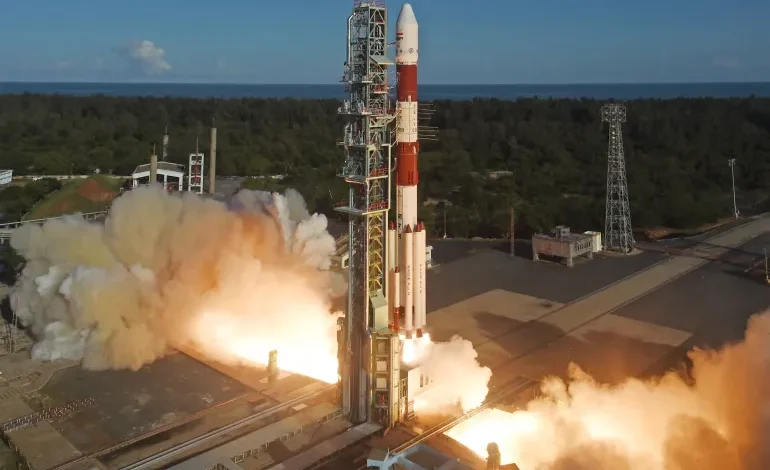

The European Space Agency (ESA) has successfully launched Proba-3, a groundbreaking mission aiming to create artificial solar eclipses for the first time, Al Jazeera reports.
Launched on December 5 from the Satish Dhawan Space Centre in India using an ISRO PSLV-C59 rocket, the mission utilizes two spacecraft working in tandem to mimic the effect of a total solar eclipse, allowing for unprecedented study of the sun’s corona.
The mission, officially titled “Project for On-Board Autonomy” (Proba-3), involves a Coronagraph Spacecraft (CSC) and an Occulter Spacecraft (OSC). The OSC, featuring a 140cm diameter disk, acts as a precisely positioned sunshade, casting a controlled shadow onto the CSC. This “precise formation flying” (PFF) requires millimetre-level accuracy to maintain a separation of 150 meters between the two spacecraft, creating an on-demand solar eclipse lasting up to six hours per orbital cycle.
The sun’s corona, its wispy outer atmosphere, reaches temperatures of 1-3 million degrees Celsius, far exceeding the 5,500 degrees Celsius of the sun’s surface. While solar flares from the corona can reach Earth, impacting satellites and systems, the corona itself is typically invisible to the naked eye due to its low brightness, visible only during rare total solar eclipses. These eclipses, visible from any given location on Earth only once every 375 years on average, last only a few minutes.
Proba-3 aims to overcome these limitations. The mission’s primary goals are twofold: demonstrating the capabilities of PFF technology, utilizing GPS and inter-satellite radio links for precise positioning and distance maintenance, and employing a sophisticated coronagraph – the Association of Spacecraft for Polarimetric and Imaging Investigation of the Corona of the Sun (ASPICCS) – to study the corona’s extreme temperature and its impact on space weather.
By creating artificial eclipses, Proba-3 eliminates atmospheric interference, providing significantly more observation time (up to six hours per 19-hour 36-minute orbit) than natural eclipses. This will allow scientists to gain a deeper understanding of the corona, ultimately leading to better prediction of space weather events and their potential effects on Earth-based technology.


The latest news in your social feeds
Subscribe to our social media platforms to stay tuned