
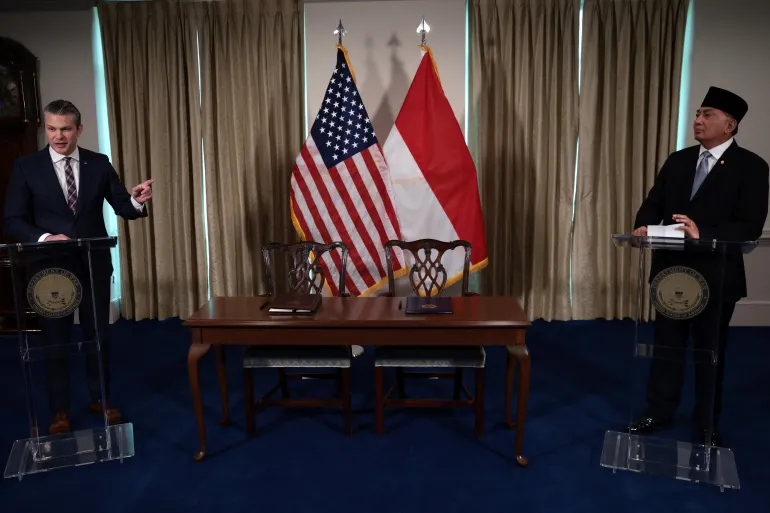




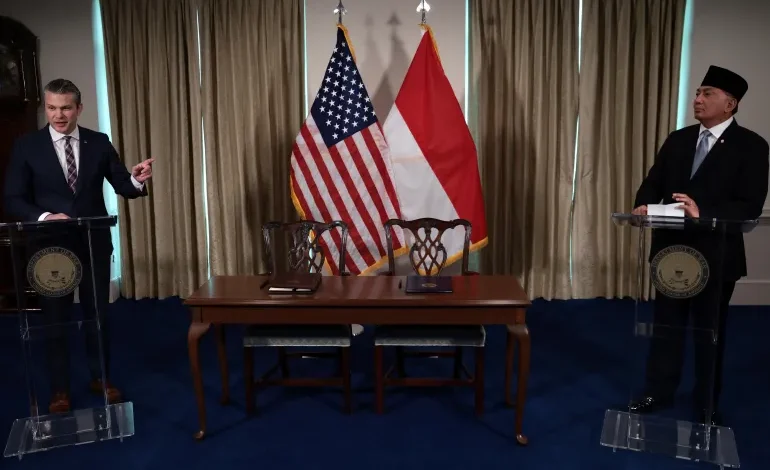

Pete Hegseth is leaning into Washington’s push to strengthen its footprint in the Asia-Pacific, announcing a new defence partnership with Indonesia that signals both strategic alignment and growing military cooperation.
The agreement was signed Monday at the Pentagon during a meeting with Indonesian Defence Minister Sjafrie Sjamsoeddin. For the US, the framing is familiar: reinforce regional stability, build deterrence, and tighten relationships with key partners.
“This [partnership] signifies the strength and potential of our security relationship… bolsters regional deterrence, and advances our shared commitment to peace through strength,” Hegeseth said, according to a Defense Department statement.
The two countries already maintain a busy military relationship, with more than 170 joint exercises each year. This new framework aims to take that further — shifting from coordination to deeper integration in areas like advanced defence technology.
A joint statement outlined plans to co-develop “sophisticated asymmetric capabilities” and invest in next-generation systems, particularly in maritime, subsurface and autonomous domains. In practical terms, that reflects where regional competition is heading: less about traditional force projection, more about technology, mobility and control of contested spaces.
From Jakarta’s side, the tone was cooperative but measured.
“We are here as Indonesian delegates… with very great enthusiasm to continue to develop our defence relationship, [which] should be enduring for our next generation in Indonesia and the United States of America,” Sjafrie said.
“We’re working on behalf of mutual respect and mutual benefit to enhance [the] value of our national interests,” he added.
The announcement comes alongside sensitive discussions about US military access to Indonesian airspace — an issue that goes directly to sovereignty. Reports over the weekend suggested Washington is seeking broad overflight rights, but Indonesian officials have pushed back on any assumption that a deal is close.
Jakarta’s Defence Ministry stressed that talks are still at an early stage, centred on a non-binding “Letter of Intent”. Officials were explicit: nothing has been finalised, and any future arrangement would remain fully under Indonesian control.
“The deal is not final. It is not legally binding. It cannot be used as a basis for official government policy,” said Sjafrie’s spokesman, Rico Ricardo Sirait.
“Authority, control, and oversight over Indonesian airspace rest entirely in our country. Any potential regulation shall guarantee Indonesia’s full authority to approve or reject any activity in national airspace,” he added.
That careful positioning reflects Indonesia’s broader approach — engaging major powers without fully aligning with any one of them.
The timing also matters. Indonesian President Prabowo Subianto is navigating multiple geopolitical relationships at once, holding talks with Russia’s Vladimir Putin and preparing to meet France’s Emmanuel Macron in Paris.
At the same time, rising global energy prices linked to the US-Israel war on Iran are already affecting domestic policy, with Jakarta introducing fuel rationing and remote work measures to manage supply.



The latest news in your social feeds
Subscribe to our social media platforms to stay tuned