
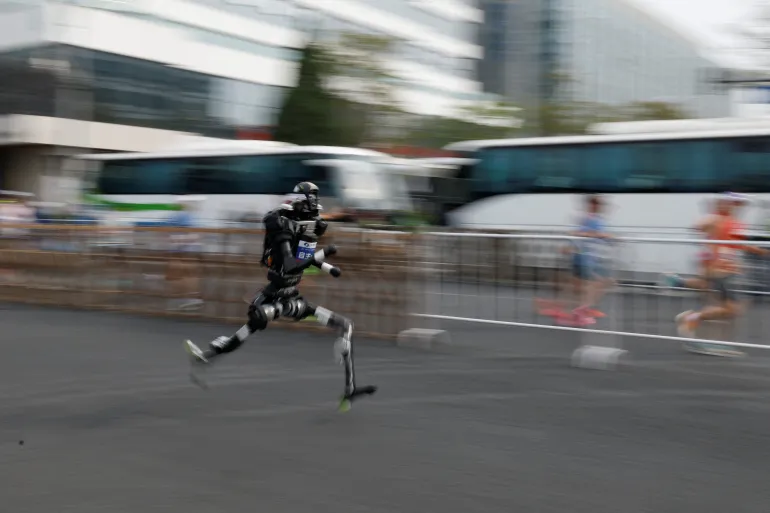




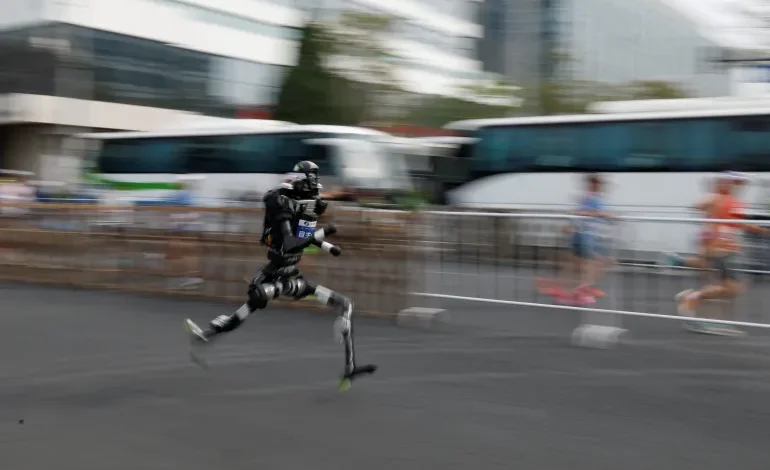

A humanoid robot has outpaced human runners at a half-marathon in Beijing, offering a glimpse into how quickly machine performance is catching up — and in some cases overtaking — human limits.
The race, held on Sunday in Yizhuang in the capital’s south, was structured to keep things controlled: robots and human runners competed in separate lanes to avoid collisions. Even so, the comparison was inevitable.
The standout performer was a humanoid built for Chinese smartphone maker Honor. Equipped with an autonomous navigation system, it completed the 21km course in 50 minutes and 26 seconds, averaging about 25km/h. That time not only beat every human competitor on the day, but also edged past the current men’s world record of 57:20 held by Ugandan runner Jacob Kiplimo.
The result marks a sharp jump from just a year ago, when robot participants struggled to stay upright and needed more than two hours and 40 minutes to finish the same distance. The improvement reflects both advances in hardware — balance, movement, endurance — and software, particularly navigation and real-time decision-making.
Participation numbers tell a similar story. Organisers reported more than 100 humanoid entries this year, up from around 20 last year, suggesting growing interest and investment in the field.
On the ground, reactions were mixed but telling. For some spectators, the speed of progress was simply impressive. One viewer described the moment as “pretty cool,” capturing the novelty of seeing machines move with near-human fluidity — and sometimes beyond it.
Others were more cautious. The same spectator added that rapid technological change brings uncertainty, especially around jobs, noting concern that advancing artificial intelligence could start to reshape the workforce.
That tension — between excitement and unease — is becoming a familiar backdrop to developments in robotics. Another attendee pointed to more practical applications, suggesting humanoid robots could soon be used for “things like housework, elderly companionship or basic caregiving” as well as “dangerous jobs, even firefighting”.
The event itself is part showcase, part signal. China has been investing heavily in robotics and embodied AI, with funding reaching 73.5 billion yuan ($10.8bn) in 2025, according to a government-backed study. Competitions like this are designed not just to test limits, but to accelerate adoption and normalize the presence of robots in everyday life.



The latest news in your social feeds
Subscribe to our social media platforms to stay tuned