

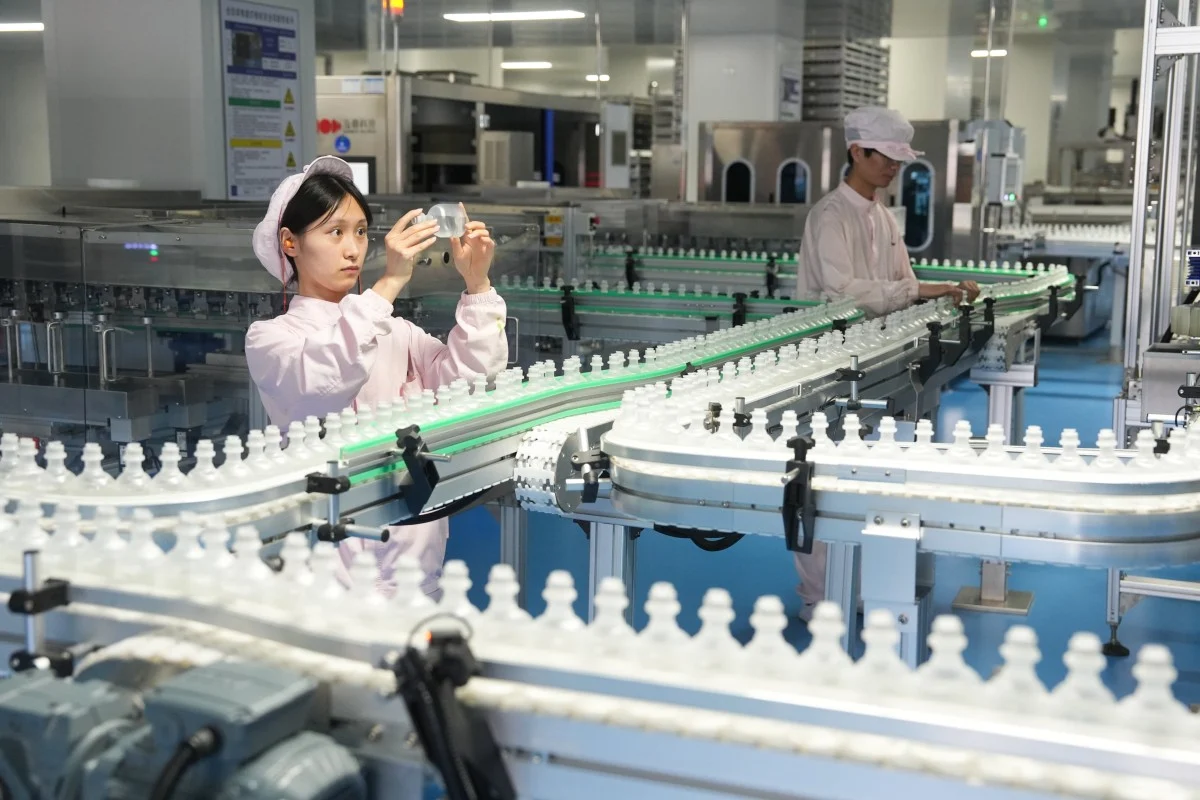




What began as a cost-driven partnership has evolved into something far more consequential. Western pharmaceutical companies are no longer turning to China simply to manufacture drugs, they are increasingly relying on it to discover them.
The shift has accelerated in the past two years. Faster clinical timelines, lower development costs, and a rapidly maturing research ecosystem have turned China into a key source of early-stage innovation. According to Evaluate, Western and Japanese drugmakers struck about 70 licensing deals with Chinese biotech firms last year, committing roughly $5.6bn upfront. Another $1.9bn has already been committed across 30 deals this year. China now accounts for nearly half of global drug licensing activity, with about 46 percent of new molecules entering human trials in early 2025 originating there.
This is not just a change in geography. It is a change in where value is created.
“It is significant, and I view it as more than a cyclical blip. This is increasingly a structural realignment in parts of biotech innovation,” David Dodd, CEO of GeoVax, said in an interview with the Wyoming Star.
What distinguishes the current moment is that China’s role has moved upstream. Western companies are not just importing finished products or manufacturing capacity, they are sourcing the underlying science. That reflects a deeper transformation in China’s biotech capabilities, driven by sustained investment in talent, infrastructure and regulatory efficiency.
“Over the last several years, China has moved from being seen primarily as a manufacturing base or regional commercial market to becoming a meaningful source of licensable drug candidates and early-stage innovation for global pharma.”
For pharmaceutical companies, the logic is straightforward. Developing drugs in-house has become slower, more expensive and less predictable. Licensing externally developed assets offers speed, flexibility and access to a broader pipeline. China’s ecosystem now provides all three, at scale.
“Licensing externally developed assets is often faster and less risky than building everything in-house, and Chinese biotech firms now offer a growing menu of credible molecules and platforms.”
But the forces behind this shift are not limited to company-level decisions. China has spent years building an environment designed to accelerate drug development, from streamlined clinical trials to coordinated industrial policy. That has allowed it to move beyond generics and into first-in-class and best-in-class innovation, particularly in areas such as oncology and AI-enabled drug discovery.
“The key point is that this is not just about lower cost anymore. China has built real discovery capability, faster development infrastructure in some areas, and a growing ecosystem that can generate assets attractive to Western partners.”
At the same time, constraints within Western systems have become more visible. Rising development costs, tighter capital markets and increasingly complex regulatory pathways have made domestic innovation slower to scale. In that context, turning outward is not just attractive, it is often necessary.
“When domestic capital becomes tighter and development costs remain high, companies naturally look abroad for efficiency. That is rational at the company level.”
The tension emerges when those rational decisions begin to accumulate. What makes sense for individual deals can, over time, reshape the entire innovation landscape.
“So yes, the shift is real. The more important question is whether the United States and its allies respond by rebuilding their own innovation and manufacturing edge, or whether they gradually normalize reliance on external ecosystems for critical parts of the biotech value chain.”
That question has moved beyond industry strategy into the realm of national policy. In Washington, concerns are growing that the US could lose high-value jobs and become increasingly dependent on medicines developed abroad, particularly as China strengthens its position across both discovery and supply chains. The country already supplies between 70 percent and 95 percent of active pharmaceutical ingredients for many essential drugs, reinforcing its central role in global production.
For Dodd, the implications are especially clear in areas where health and security intersect.
“In areas like vaccines, biodefense, and outbreak preparedness, innovation cannot be separated from national security.”
The risk is not only disruption, though recent global shocks have exposed vulnerabilities in supply chains, but a gradual erosion of capability. If critical knowledge, infrastructure and manufacturing capacity migrate elsewhere, rebuilding them in a crisis becomes significantly harder.
“If a country becomes too dependent on foreign ecosystems for critical science, manufacturing inputs, or product platforms, it loses resilience precisely where resilience matters most.”
That loss of resilience is tied to a broader structural shift. As more early-stage innovation originates outside the West, the balance of power in the industry begins to change. Even if Western companies continue to lead in commercialisation, the upstream engine of discovery may increasingly sit elsewhere.
“The first risk is strategic dependency. If too much of the Western pipeline begins to depend on assets sourced externally, especially from geopolitical competitors, then innovation leadership gradually shifts with it.”
Geopolitics adds another layer of complexity. US-China tensions have already begun to affect supply chains, partnerships and regulatory decisions. Even when both sides have an interest in maintaining cooperation, political friction can introduce uncertainty into an industry that depends on long timelines and stable conditions.
“The second risk is vulnerability to political or trade disruption. Even where both sides want business continuity, geopolitical friction can interrupt partnerships, sourcing, timelines, and market access.”
At the same time, the shift creates a feedback loop. As more companies look abroad for innovation, incentives to invest in domestic capabilities weaken, further accelerating the trend.
“Once investors, policymakers, and companies assume that the best or fastest innovation will come from abroad, the incentive to fund local platforms, manufacturing infrastructure, and translational science weakens. That becomes a self-reinforcing cycle.”
For now, collaboration remains central to global drug development. Scientific progress has always crossed borders, and the integration of research ecosystems has contributed to advances in patient care worldwide. But the current moment is testing where the line between collaboration and dependence lies.
“My view is that the answer is not isolationism. Global science collaboration has real value. But the West needs to distinguish between collaboration and dependency.”


The latest news in your social feeds
Subscribe to our social media platforms to stay tuned