

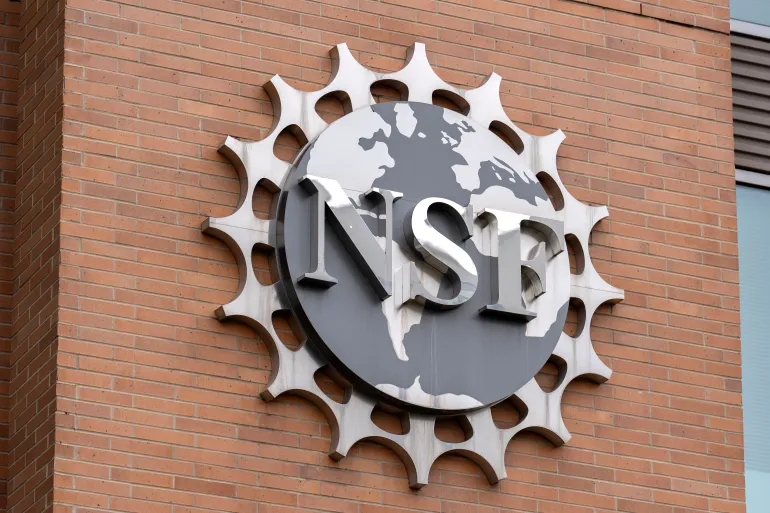




The Trump administration has dismissed all 22 members of the National Science Board, the body that helps shape policy at one of the United States’ most important research agencies, in a move that underscores its broader effort to reshape federal institutions.
The firings, confirmed by a former board member and lawmakers, affect the advisory arm of the National Science Foundation (NSF), an independent agency that funds billions of dollars in scientific research each year. The decision comes amid a wider push by the administration to overhaul government structures, following deep cuts to agencies such as the Department of Education and USAID.
Roger Beachy, an emeritus biology professor at Washington University in St Louis who had been reappointed to the board by Trump in 2020, said members were given no explanation for their removal.
“The termination email was brief and to the point, with a ‘thank you for your service,’” Beachy said.
While he expects a new board to be appointed, Beachy pointed to the stakes behind the change. The composition of the board — and its relationship with the NSF — plays a central role in determining what kind of research gets funded and how the agency operates.
“The nature of the board – partisan or independent? – and how it interacts with the agency is of critical importance to the continuing success of the NSF,” he said.
The move has drawn sharp criticism from Democratic lawmakers, who see it as part of a broader pattern of political interference in scientific institutions.
“This is the latest stupid move made by a president who continues to harm science and American innovation,” said Representative Zoe Lofgren, the senior Democrat on the House science committee.
“Will the president fill the NSB with MAGA loyalists who won’t stand up to him as he hands over our leadership in science to our adversaries?” she added, calling the decision a “real bozo the clown move”.
The White House has not publicly commented on the dismissals, and the NSF has yet to respond to requests for clarification.
The agency itself sits at the centre of the US research ecosystem. Founded in 1950, the NSF distributed more than $8bn in funding in 2025, supporting work across disciplines from basic science to advanced technology. Its role has historically been insulated from political swings, with bipartisan backing seen as essential to maintaining long-term research capacity.
That stability has already been tested. Last year, under a cost-cutting initiative led by Elon Musk’s Department of Government Efficiency, more than 1,600 NSF grants worth nearly $1bn were scrapped or halted.
Against that backdrop, the removal of the board raises new uncertainty about the direction of US science policy. Beachy cautioned that the long-term impact remains unclear, but emphasised the importance of continued cross-party support.
“It is important to note that support for the NSF, both statutorily and in terms of its budget, has been bipartisan in the past,” he said.
“If such support continues, we can have greater optimism for its future and can look forward to the continuing excellence of the US science enterprise.”



The latest news in your social feeds
Subscribe to our social media platforms to stay tuned