
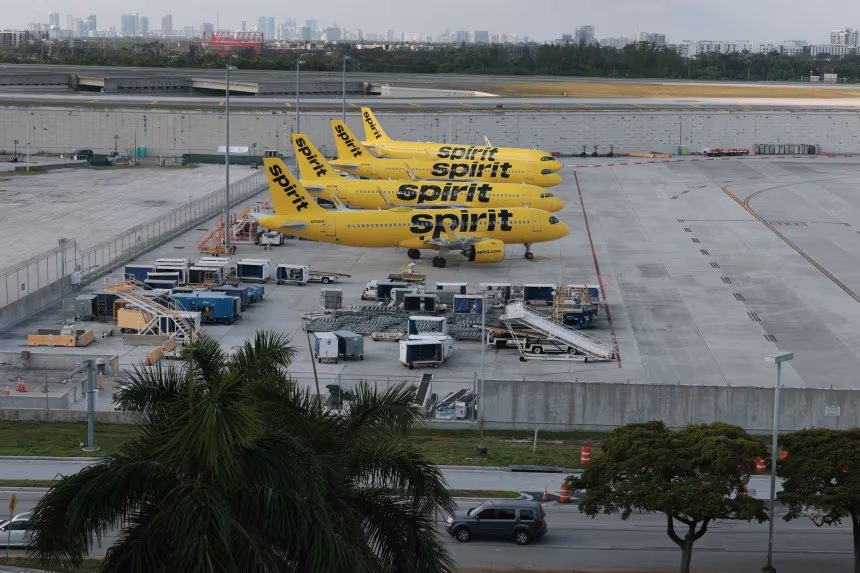

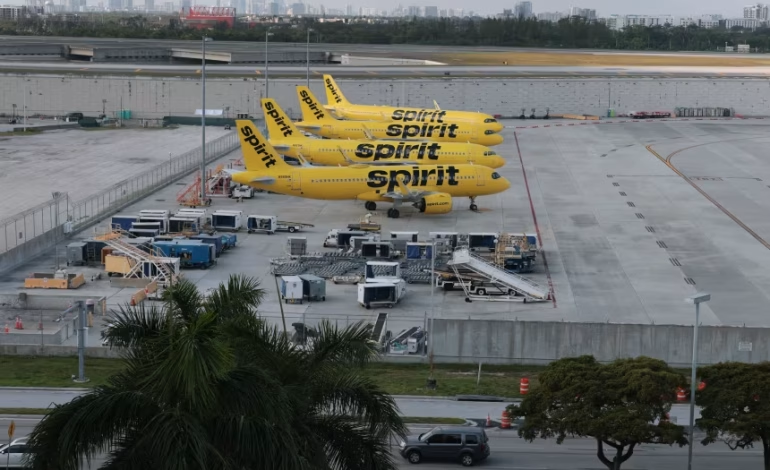

For weeks, Trump administration officials were in talks with Spirit Airlines about a potential $500 million bailout package that would have given the government control of the overwhelming majority of the bargain carrier’s shares. President Donald Trump publicly suggested he would be on board “if we can get it at the right price.” But after internal divisions, creditor resistance, and no clear funding source, the deal collapsed—and Spirit began an “orderly wind-down” of its operations in the early hours of Saturday morning.
Spirit had filed for bankruptcy for the second time in August 2025. Months later, the conflict with Iran drove up fuel prices, making its financial position untenable. Transportation Secretary Sean Duffy and Commerce Secretary Howard Lutnick met with Trump to lay out options, prompting internal division. Lutnick pushed for a deal, arguing it would be a political win, according to sources familiar with the deliberations. But officials including Duffy, Trump deputy chief of staff Stephen Miller, and National Economic Council Director Kevin Hassett raised concerns about pumping money into a company with a poor financial record.
The idea of a single-airline bailout also sparked backlash from the industry and from Republicans in Congress. Previous bailouts had supported all U.S. airlines in response to a paralyzed industry after terrorist attacks or a pandemic—not because of increased costs and losses.
Trump, Duffy told reporters Saturday, “was like a dog on a bone trying to figure out a way to keep Spirit afloat.” But a bailout proved more complex than Trump’s efforts to gain government control over companies like U.S. Steel. The possibility of invoking the Defense Production Act was raised but rejected by the Department of Defense. Officials were never able to identify a funding source for the $500 million.
On Thursday, the White House gave Lutnick the word to tell Spirit CEO Dave Davis there would be no bailout. That evening, they “left open the possibility of a Hail Mary,” a source said, “but there was the determination that we have to start putting things in motion to wind this down.”
Then, early Friday afternoon, Trump expressed optimism that a plan could materialize. “We’re looking at it,” he told reporters. “We gave them a final proposal.” His comments, a source said, brought “new life” to the possibility, and stakeholders “were holding out hope.” But Trump did not follow up. While Lutnick continued to push, Trump did not directly engage with Davis or key creditors.
Later Friday, Spirit began canceling flights. By 11 p.m., union leaders were told there would be no deal. Around 2 a.m., after the final Spirit plane landed, the company announced it had “started an orderly wind-down of our operations, effective immediately.”
Duffy said Saturday that creditors failed to agree to a deal. “In the end, this was a creditor issue,” he said. “Also from the government’s perspective, we oftentimes don’t have a half a billion dollars laying around in a spare account.”
Trump allies shifted blame to Democratic Sen. Elizabeth Warren and the Biden administration, pointing to a federal judge’s ruling that blocked JetBlue’s proposed purchase of Spirit due to antitrust concerns. Warren shot back that “spiking fuel prices from Trump’s war was the nail in the coffin.” Duffy also blamed the Biden administration, saying history would judge the merger denial “a massive mistake.”
Spirit’s demise has stranded thousands of passengers. Duffy announced that United, Delta, JetBlue, Southwest, American, Allegiant, and Frontier are offering capped fares, reduced rates, or discounts for Spirit customers. But the closure could have broader effects on prices and make air travel less accessible. “It’s another blow to the working class,” a source said. “People who fly Spirit fly at a bare minimum, and now they don’t have another option.”

The latest news in your social feeds
Subscribe to our social media platforms to stay tuned