


Armenia’s Election and the Art of the Accusation

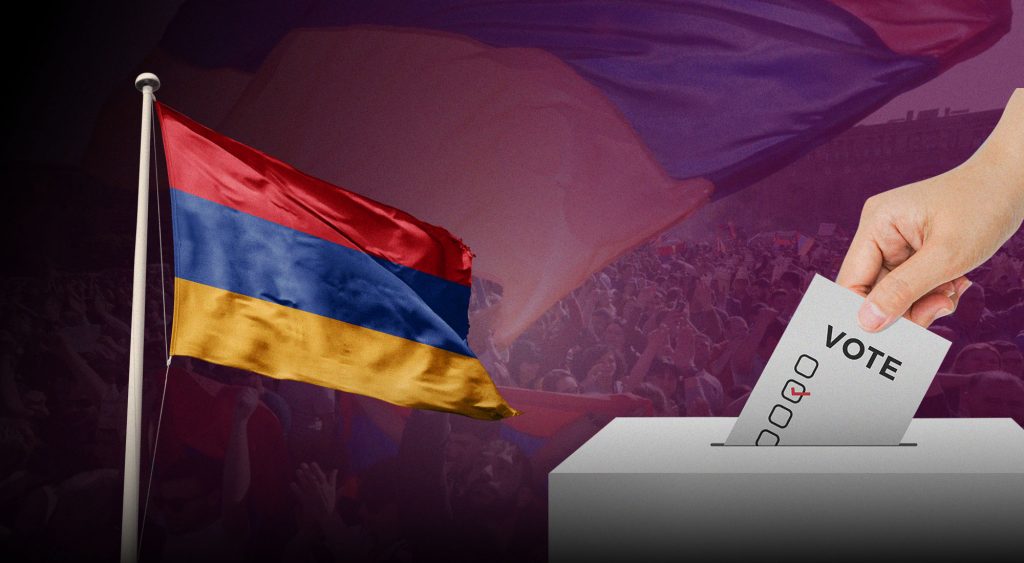
On May 19, in a conference room not far from Republic Square, a youth-led observer mission called “Fair Vote” will unveil a digital platform for reporting electoral violations. The Federation of Youth Clubs of Armenia, the country’s largest youth NGO, has spent months training hundreds of young Armenians to fan out across polling stations on June 7. Their mission is straightforward: watch, document, report. What they might find, however, sits at the center of a political firestorm that has turned Armenia’s first scheduled parliamentary election since 2017 into something closer to a referendum on the man who has dominated the country for eight years – and on the methods he is willing to use to keep it.
Looks like PM Nikol Pashinyan is running against the very idea that the opposition can be legitimate at all.
Over the past two months, the prime minister has constructed a narrative that is as effective as it is blunt. His main challengers, he argues, are not political rivals with a different vision for Armenia. They are instruments of foreign powers. Billionaire Samvel Karapetyan, whose Strong Armenia party is seen as the ruling Civil Contract party’s most formidable opponent, has been branded a “foreign spy.” Pashinyan claims the authorities have compiled a “thick file” of individuals acting in line with foreign agendas.
“If those people are still at large,” he said in April, “it means they have not yet crossed the line into espionage, but they are acting within that logic. Once they cross it, there will be a response.”
Former president Robert Kocharyan, whose Armenia Alliance is also contesting the election, has been told he will be sent back to prison. Speaking to journalists on May 15, Pashinyan promised that opposition leaders who are “obvious participants in crimes” would “go to jail in accordance with the laws of the Republic of Armenia.”
Gagik Tsarukian, the Prosperous Armenia leader, has faced similar rhetorical bombardment. The prime minister has lumped all three into what he calls a “three-headed war party,” a formulation designed to fuse the opposition in the public mind with the specter of renewed conflict with Azerbaijan.
“Armenia would face a war if the opposition came to power,” Pashinyan has repeatedly claimed.
No one in their right mind would want a foreign agent in control of their country. That is precisely what makes the accusation so politically potent – and so difficult to disprove. Painting local opposition in the same shade as genuine foreign interference is a tactic that sidesteps debate over policy and relocates the argument onto terrain where the government holds all the cards: intelligence briefings the public cannot see, assessments it cannot verify, and a security apparatus that has demonstrated its willingness to act.
The arrests have not been limited to rhetoric. Twenty-two supporters of Karapetyan were detained in a single day in April on vote-buying charges the bloc denies. Ten more were arrested in mid-May after an altercation with Civil Contract campaigners in the Lori region. Law-enforcement authorities have opened at least 11 criminal cases against Strong Armenia alone. The Hayastan alliance has also been hit, with its first election-related arrests coming in May. Opposition figures describe an expanding pattern of pressure.
The Parliamentary Assembly of the Council of Europe, which sent a pre-electoral delegation to Yerevan, has called on Armenian authorities to ensure the vote is held “in a climate free from intimidation, foreign interference, and abuse of administrative resources.” The International Republican Institute’s pre-election assessment, conducted from April 20 to 24, found that while technical preparations were on track, concerns about “opaque pre-campaign spending, information manipulation, political polarization, and efforts by international and domestic actors” to exploit the debate were “credible and significant.”
The administrative pressure allegations are not coming solely from opposition partisans. Reports have surfaced of regional governors being instructed to organize mass rallies for the ruling party, of schools and social services being treated as extensions of the campaign apparatus, and of pre-campaign spending that dwarfs the official limits. The campaign period officially began on May 8, but as one Armenian newspaper noted, “the political processes are actually already in an active phase” well before that date. The Central Electoral Commission, by several accounts, has been unable to keep pace.
What makes all of this more than a domestic political story is the international dimension that Pashinyan himself has placed at the center of his campaign. Armenia is pivoting westward at extraordinary speed. The EU flag flew alongside the Armenian tricolor at the first-ever EU-Armenia summit on May 5. French President Emmanuel Macron flew to Yerevan and offered an unabashed electoral endorsement, declaring that Armenia’s “destiny lies with Europe.” The European Commission’s Ursula von der Leyen called the relationship a “new era.” Pashinyan has adopted a “Real Armenia” ideology that accepts the country’s internationally recognized borders, seeks peace with Azerbaijan, and frames the EU as the guarantor of prosperity and security.
This is a genuine strategic reorientation. It also provides Pashinyan with a powerful campaign weapon. By framing his opponents as agents of Moscow, he positions himself as the only figure standing between Armenia and a return to Russian domination. The fact that some opposition figures do have ties to Russia – Karapetyan is a Russian-Armenian billionaire; Kocharyan was president during an era of close Kremlin alignment – gives the accusation a veneer of plausibility. But the line between “has ties to Russia” and “is a Russian agent” is a long one, and Pashinyan has spent the pre-election period erasing it.
The opposition, for its part, has been fragmented and often its own worst enemy. Nineteen parties and alliances are contesting the election, a number that virtually guarantees the opposition vote will be split. Pashinyan’s approval rating, which stood at 82% in 2018, has fallen to slightly over 10%, according to some measures. An IRI poll from March showed only 24% of respondents would vote for Civil Contract again. Yet the fractured field, combined with the incumbency advantages Pashinyan enjoys, means he remains the probable winner.
The DGAP, a German think tank, has warned that Armenia is undergoing a “process of hybridization, in which formal democratic institutions coexist with increasing personalization of power, weakened institutional autonomy, and a deeply polarized political landscape.”
The observers from FYCA’s “Fair Vote” mission will fan out on June 7 with their checklists and their hotlines. The OSCE will deploy its own mission, as will the CIS. The cameras will be rolling. Pashinyan has bet that Armenians will choose Europe and him. The price of that bet is being paid in the currency of democratic norms, and the bill is coming due.

The latest news in your social feeds
Subscribe to our social media platforms to stay tuned