

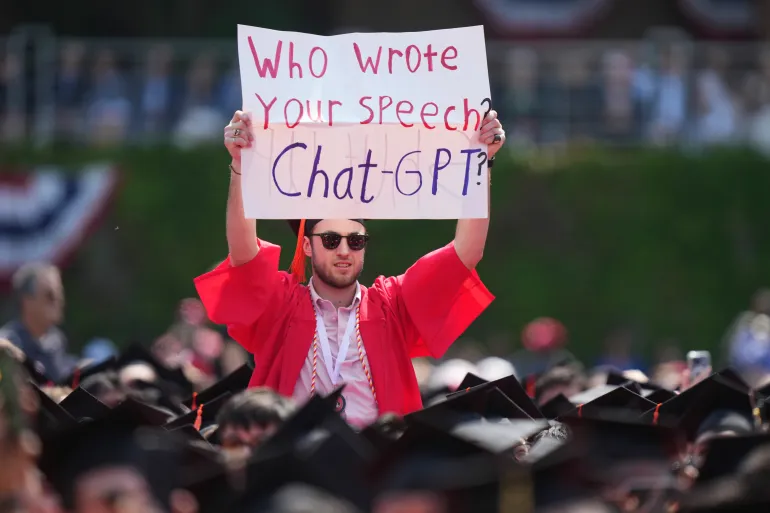


Every May, Washington Square Park fills with new graduates in caps and gowns, many of them in NYU purple, posing for photos at the edge of one life stage and the beginning of another. The ritual still looks celebratory. The job market waiting outside the frame does not.
Julie Patel, who recently completed a master’s degree in public health, is one of the graduates facing that harsher reality.
“I think expectations of when I came into this programme and coming out of it in terms of a job search, funding and what’s available are two very different things,” Patel told Al Jazeera.
She is entering a labour market that looks stable from a distance but much tighter up close, especially for recent graduates. Hiring has slowed, workers already in jobs are staying put, and entry-level candidates are competing not only with one another but with people who have more experience and fewer places to go.
The latest Job Openings and Labor Turnover Survey from the United States Bureau of Labor Statistics showed 6.9 million open jobs in March, with hiring rising only modestly to 5.6 million. Separations stood at 5.4 million, suggesting that the usual churn in the labour market has weakened.
“The depressed hires rate suggests that it is more difficult for new entrants to get a foothold in the labour market,” Elise Gould and Joe Fast wrote in an analysis for the Economic Policy Institute.
“The quits rate is down, signalling a reduction in the overall churn in the labour market as workers and employers sit tight through this period of economic uncertainty, likely related to chaotic policy decisions and implementation around tariffs, deportations, and the conflict with Iran.”
The latest jobs report showed the US economy added 115,000 jobs, with gains concentrated in healthcare, transportation and retail. But white-collar sectors looked weaker. Financial activities lost 11,000 jobs, while information services shed 13,000.
For the class of 2026, the timing is rough. Job growth has slowed sharply from the stronger post-pandemic years, and the hiring environment has shifted into something more cautious.
“We have this kind of no-hire, no-fire environment right now,” said Aleksandar Tomic, associate dean for strategy, innovation, and technology at Boston College.
“We don’t see as much labour turnover as we normally would, and with the layoffs, we now have more experienced workers looking for jobs who will probably elbow out recent college graduates.”
For graduates in public health, international affairs and research, the pressure is especially visible. Government funding cuts have hit universities, public agencies and research institutions — exactly the kinds of employers many students expected to pursue.
The Department of Government Efficiency, led last year by Elon Musk, cut a range of federal programmes and funds under the banner of reducing waste. Among the cuts were roughly $4bn in research funding awarded by the National Institutes of Health.
Those cuts have rippled through universities. Duke, Harvard, the University of Maryland and Princeton are among the institutions that have imposed hiring freezes or job cuts, narrowing the path for graduates looking for research roles.
“We’re competing not only with our cohort, but also last year’s cohort and fighting with people whose jobs have been defunded, with more experience, and everything has also been extremely difficult,” said Molly Howard, Patel’s classmate.
The squeeze is also affecting those looking toward public service. Federal employment fell by another 9,000 jobs in April and is down 348,000 from its October 2024 peak.
For Cathleen Jeanty, who is earning a master’s degree in international affairs from Columbia University, that has made the search feel unusually crowded.
“I feel like I found myself competing for internships with people who are graduating, and then the people who are graduating are competing for jobs with people who lost their jobs due to funding cuts, the closure of USAID [US Agency for International Development], the UN’s funding cuts, et cetera,” Jeanty said.
“It kind of feels like everyone is competing with people you would assume they would not be competing with.”
Artificial intelligence is adding another layer of pressure. Entry-level roles are among the first to be reshaped or eliminated as companies automate tasks once assigned to junior workers.
A Stanford Digital Economy Lab analysis found a 16 percent decline in relative employment for early-career workers in AI-exposed sectors, including software engineering and customer service roles, while employment growth for more experienced workers has remained more stable.
“AI is really disrupting the entry-level job market. We’re seeing evidence of that. It’s doing two things: making it more difficult for entry-level candidates, while also increasing demand for more experienced workers,” Tomic said.
The trend is expected to continue. A Goldman Sachs survey found that advances in AI are translating into an average of 16,000 jobs being cut from the economy each month. Anthropic CEO Dario Amodei has repeatedly warned that AI could eliminate half of entry-level white-collar jobs within the next five years.
That shift is being felt sharply by younger workers. According to a Gallup survey, only 22 percent of Gen Z respondents said they were excited about AI, down 14 percentage points from a year earlier.
“For the first time in decades, college graduates are coming into a labour market where they are competing against their peers, millennials, Gen X, and, in some cases, baby boomers who have recently been laid off due to the uptick in AI. In many instances, entry-level roles have been eliminated and fully replaced by AI,” said Stephanie Alston, CEO of recruitment firm BGG Enterprises.
AI is not only changing the jobs available. It is also changing the process of getting one.
Applicants are using AI-assisted resumes, employers are drowning in applications, and fake candidates are becoming a growing concern. Consulting firm KPMG forecasts that by 2028, one in four job applicants will not even be real.
Some candidates are now being interviewed by AI recruiters before they ever speak to a human being.


The latest news in your social feeds
Subscribe to our social media platforms to stay tuned