




Pilot Peak Is One Of Yellowstone’s Most Famous Mountains, And Toughest To Climb


Pilot Peak, the sharp 11,699-foot summit on Yellowstone’s eastern edge, is one of Wyoming’s most recognizable mountains. Often called a “mini-Matterhorn” because of its striking appearance, it is also one of the state’s toughest climbs. “There are more technically challenging climbing routes in the state to be sure, but Pilot Peak is one of the most challenging summits to attain by its easiest route,” said Zach Lentsch, owner of Wyoming Mountain Guides.
Many sources say Pilot Peak was a critical landmark for the 1870 Washburn Expedition, but Thomas Turiano, author of “Select Peaks of Greater Yellowstone: A Mountaineering History & Guide,” said that account is more fiction than fact. “It was actually an 1869 mining expedition,” he told Cowboy State Daily. “They were going from Emigrant to Cooke City. They were climbing high, and every time they crested a ridge, they’d be like, ‘Oh, there’s that sharp pointy dagger-like peak, let’s keep on that target.'”
The mountain was officially named by geologist Ferdinand Hayden during the 1871 Hayden Geological Survey. He wrote that one of the mountains derives its name “from its shape, like a closed hand with the index-finger extending upward,” and that it forms “an excellent landmark for the wandering miner.” Hayden was so enthralled by the Absaroka Range that he called it “one of the most symmetrical and remarkable ranges of mountains I have ever seen in the West,” with Pilot Peak appearing as “the leader.” Bart Henderson, a founder of Cooke City, Montana, had a less inspired name: “Dog Turd Peak.” Hayden’s name stuck.
The first documented ascent occurred on Aug. 12, 1932, when Robert McKenzie and Hollis Mees reached the summit. “One was a wrangler, the other was a highway worker,” Turiano said. “These guys became friends somehow and reached the top with no ropes or climbing equipment. That has baffled mountaineers forever.” The second summit was achieved by legendary Wyoming mountaineer Phil Smith on Sept. 15, 1940, establishing the standard route still used today. Smith needed belayed rope pitches, rappels, and considerable expertise. When he reached the top, he found a ram skull. “The ram either couldn’t or didn’t want to get down and went up there to die,” Turiano said. “Somehow, the ram and the Cowboys were the better route finders than he was.”
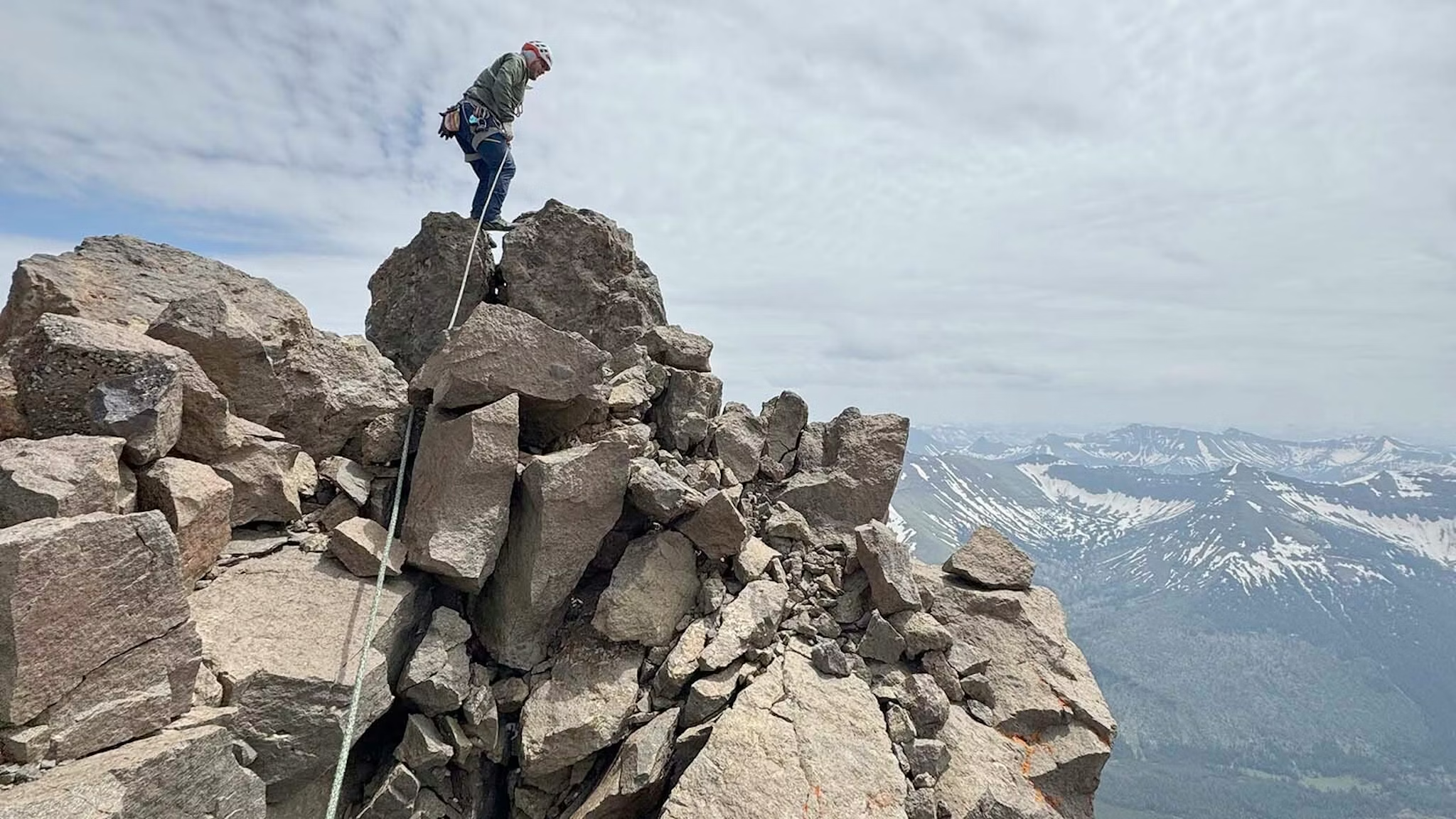
Pilot Peak is a glacial horn, formed by multiple glaciers eroding from a central point. Climbing it is daunting. “There’s not a non-technical route up the peak,” Lentsch said. “A climb of Pilot often involves both technical snow and steep rock climbing at considerable difficulty on loose volcanic rock.” Breccia and trachyandesite give the mountain its beautiful but crumbly texture, making for less-than-ideal climbing. Turiano called his one summit “magical but harrowing.” “If you compare the easiest routes on Grand Teton and Pilot Peak, Pilot is harder and more technical,” he said. “You got to be good with loose rock, and extreme exposure on loose rock. Lots of sloping ledges with scree overhanging cliffs. It’s not for casual mountaineers.”
Wyoming Mountain Guides offers custom guided climbs of Pilot and Index Peak for experienced mountaineers. A full climb takes 10 to 12 hours. Lentsch said climbers need “plenty of experience mountaineering and climbing on loose alpine rock, advanced knowledge of traditional rock-climbing protection systems, and a good ability to route find.” The mystery of how McKenzie and Mees—in work boots, not cowboy boots—made the first ascent remains unsolved. “They raved about it for the rest of their lives, but never made a big deal out of it,” Turiano said. “They went back to their lives and didn’t seek attention.”


The latest news in your social feeds
Subscribe to our social media platforms to stay tuned