

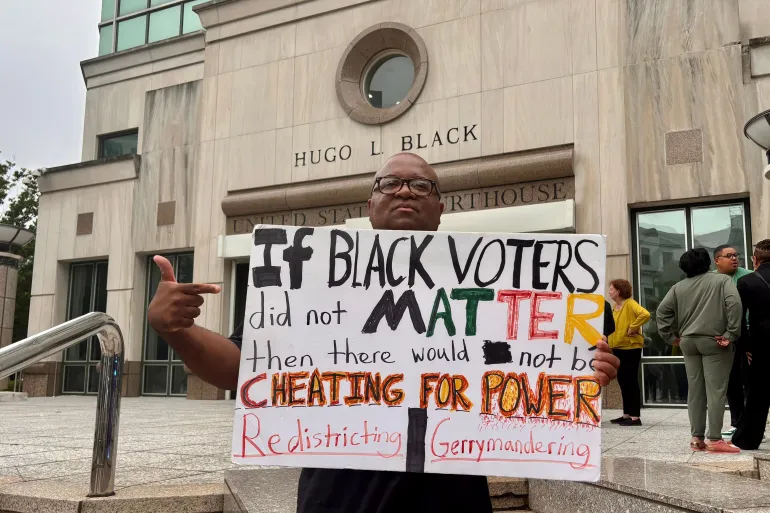




Republicans in Alabama are asking the US Supreme Court to reinstate a congressional map previously ruled racially discriminatory, escalating a broader national battle over redistricting ahead of the 2026 midterm elections.
In a filing submitted Wednesday, Republican leaders in the state urged the court to act quickly so the disputed map could be used in next year’s elections. The request follows a major Supreme Court ruling earlier this year that weakened parts of the Voting Rights Act traditionally used to challenge racially biased district maps.
At the center of the dispute is Alabama’s 2023 congressional map, which lower courts found intentionally diluted the political influence of Black voters.
A three-judge federal panel ruled at the time that Alabama should contain two Black-majority congressional districts: one centered around Birmingham and another around the state capital, Montgomery. Black voters in Alabama overwhelmingly support Democratic candidates, making the map politically significant in a tightly divided Congress.
The US Supreme Court initially declined to overturn that ruling in 2023. But last month’s decision in Louisiana v Callais reshaped the legal landscape around redistricting challenges, giving Republican-led states new grounds to revisit previously rejected maps.
Alabama Republicans now argue that the earlier court ruling no longer holds under the Supreme Court’s updated interpretation.
Their proposal would once again consolidate much of Alabama’s Black voting population into a single district — a structure critics say weakens Black representation in Congress.
In Wednesday’s filing, Republican officials argued immediate intervention was needed to avoid “irreparable harm”.
“Worse still, voters will be forced to vote under a court-drawn racially gerrymandered map that does not meet Alabama’s legitimate districting goals,” they wrote.
The legal fight highlights how aggressively both parties are now approaching congressional mapmaking ahead of the midterms, where control of the House of Representatives could hinge on only a handful of districts.
Currently, Republicans hold a narrow House majority with 217 seats out of 435.
Former and current President Donald Trump has made redistricting a major political priority, openly pressuring Republican-led states to redraw maps in ways that could preserve GOP control of Congress.
That push intensified after reports emerged in 2025 that Trump allies encouraged Texas lawmakers to redesign congressional districts to reduce Democratic competitiveness. Texas later approved a new map expected to favor Republicans by roughly five additional seats.
Democratic-led states responded with similar moves. California voters approved a ballot initiative last year aimed at reshaping districts to improve Democratic chances in future House races.
The result has been a nationwide redistricting arms race, with states increasingly revisiting maps outside the traditional once-per-decade census cycle.
Alabama’s case also reflects the growing importance of the Voting Rights Act in the redistricting debate. For decades, the law served as one of the few remaining legal limits on racial gerrymandering in congressional maps.
But voting rights advocates argue the Supreme Court’s recent decisions are steadily weakening those protections.
On Tuesday, a lower court once again rejected Alabama’s disputed map, dealing another setback to the state’s Republican leadership.
“The court saw through Alabama’s blatant attempt to reinstate a race-based congressional map that the legislature deliberately enacted to deny Black voters a voice in Congress,” plaintiffs said in a statement released by the American Civil Liberties Union.
If the Supreme Court sides with Alabama Republicans, the state may hold new primary elections in four congressional districts later this year, forcing some voters to cast ballots twice under newly drawn boundaries.
Meanwhile, similar legal and political fights are unfolding across the country. Tennessee Republicans are considering reshaping a Democratic-leaning Memphis district, while Louisiana Republicans are preparing new maps following the Supreme Court ruling. South Carolina lawmakers, however, recently delayed a controversial redistricting proposal as early voting already began in the state.
For Trump and Republicans, the stakes are openly political. Trump has repeatedly warned party leaders that losing control of Congress could threaten his presidency itself.
“You’ve got to win the midterms because, if we don’t win the midterms, it’s just going to be — I mean, they’ll find a reason to impeach me,” Trump told Republican leaders earlier this year.


The latest news in your social feeds
Subscribe to our social media platforms to stay tuned