




For several centuries of Western history, conventional armed conflict was so regimented that forces literally faced each other on open fields or open seas and fought army to army, navy to navy, until there was a clear victor or both sides had to withdraw. Deceit, attacks on strategic infrastructure, and traumatization were always part of the concerns around war, but it was often considered ignoble and dishonorable to use those aspects of warfare to one’s advantage. In recent decades, however, wars have been waged on the civilian population, a much more intentional focus than just inflicting harm on civilians as part of a strategic and tactical approach. As Pope Leo IV recently put it:
The past 60 years have been marked by conflicts of astonishing brutality, often affecting civilian populations on a massive scale.
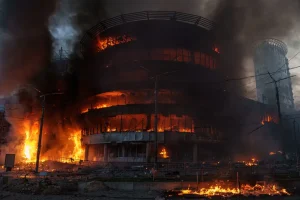
While Western powers had begun developing military doctrine around “civilian harm mitigation,” it seems that the goal of most current armed conflicts is to traumatize the civilian population to the point of capitulation. And capitulation either means to comply with the desires of the attacking party or leave and relinquish the territory they occupy. In other words, the goal is civilian harm, as that has become the means to the desired ends.
When Russia moved on Crimea in 2014, it did not want to expel the population, it wanted to Russify the population. When Russia moved on the rest of Ukraine in 2022, it wanted the same thing. The Russian armed forces have taken over 2,000 Ukrainian children and traumatized civilians across the country with attacks on homes, hospitals and infrastructure. Ukraine’s severe winters became all the more brutal without power or fuel on account of Russian attacks, and while the determination of the Ukrainians to maintain their sovereignty continues to impress the world, the Russians continue to seek to break it.
When Israel moved on Gaza following the horrific attack of 7 October 2023, it did not want to take over Gaza and absorb the Palestinian population the way the Russians wanted to do in Ukraine. Much like the longstanding and now accelerating issue of Israeli settlers in the West Bank forcing out the Palestinian population, the Israelis used this war to destroy most of Gaza in an effort to break the Palestinians’ tie to the land. As Israel displays its remarkable capabilities to collect intelligence and engage in precision targeting in Iran, it is clear that the wholesale destruction of civilian homes, hospitals and infrastructure in Gaza was poorly justified by an alleged blurring of civilian and military targets by Hamas. The extent of the devastation leaves little room to argue that that devastation was not the point.

In 2022, the United States Department of Defense developed a significant framework for “civilian harm mitigation.” The whole point was to enhance compliance with international law and to do a better job of protecting non-combatants amid armed conflict. A Civilian Protection Center of Excellence was established to provide the United States armed forces with guidance on civilian harm mitigation at every level. In other words, it was intended to affect decision-making about strategy, operations and tactics, and ensure that protecting civilians was part of how the United States fought wars.
In 2025, that framework was revoked by the new administration, the Center of Excellence was closed, and the focus shifted to “lethality.” Recent Congressional hearings confirmed that the staffing in this area was reduced from 10 to 1. As the United States now pursues wars on multiple fronts, it is clear that the avoidance of civilian harm is no longer a priority. Attacks on Iranian civilian infrastructure and threats to its power grid indicate a desire to traumatize the civilian population into capitulation – not to surrender land, but to accede to intimidation.
At the same time, the United States has been squeezing the life out of the Cuban population, employing what some call an “anaconda” approach. In other words, by depriving the civilian population of access to key goods – energy, food and medicine – the United States is pushing that population to the breaking point. Similar to what the US is doing in Iran, the goal seems to be capitulation. And equally similar, it is not clear what the desired end state is: regime change? Surrender of territory? Something else? It remains to be seen how that will play out, but traumatizing the civilian population seems to be the means toward whatever goal the administration has. This sort of cruelty echoes the constrictive brutality of medieval sieges.

Incidentally, the United States administration has employed a similar approach on the homefront. Domestically, the Director of the Office of Management and Budget indicated that his approach to the federal workforce was literally to keep them “in trauma.” And as much as the United States is waging war overseas, it has been aggressively antagonizing the civilian population within the country as well. In Minnesota, where Immigration and Customs Enforcement notoriously shot to death two American citizens amid Operation Metro Surge – a crackdown on the “worst of the worst” illegal immigrants – data has since revealed that of the roughly 3,700 people who were arrested, nearly three quarters of them had no criminal record. Once again, it seems the effort is to break the civilian population such that they capitulate to the administration’s agenda.
While it is understandable that weaker parties like the Houthis or even Iran under attack would engage in asymmetric hostilities against civilian actors – in both cases, against the merchant ships and seafarers responsible for global trade – it is a different situation when the stronger aggressor takes direct aim at the civilian world. Aggressors have a choice, and increasingly the choice seems to be to threaten and inflict civilian harm in order to gain a strategic military advantage.
International law is failing to constrain actors in how they wage war. The very principle of civilian harm mitigation has been expressly rejected by the world’s most powerful armed force. If this is the new normal, we must find new approaches to protecting non-combatants. Brutalizing civilians has already crossed from the battlefield to domestic law enforcement. Without some new guardrails, how much inhumanity are democracies prepared to tolerate?



The latest news in your social feeds
Subscribe to our social media platforms to stay tuned