





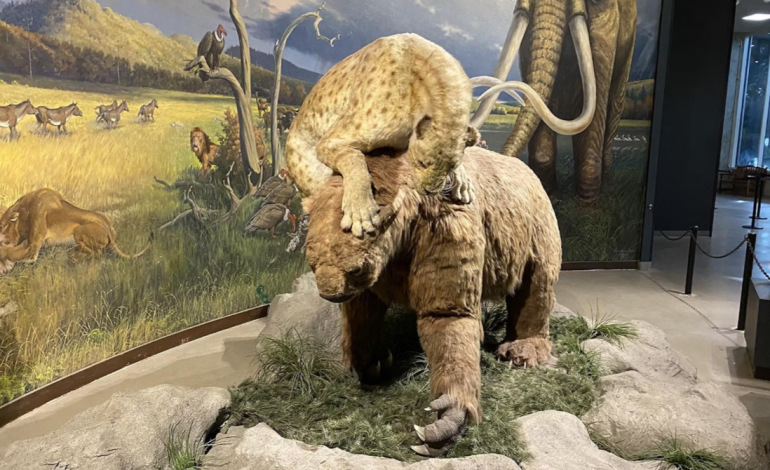

Natural Trap Cave near Lovell, Wyoming, stands out as one of the world’s premier Ice Age fossil sites, offering a rare glimpse into Wyoming’s ancient ecosystem, Cowboy State Daily reports.
However, despite yielding numerous fossils from the Late Pleistocene era, this remarkable site lacks remains of two iconic species: saber-toothed cats and giant ground sloths, which roamed much of North America but likely avoided the arid, open landscape of prehistoric Wyoming.
Located in the Bighorn National Forest, Natural Trap Cave is an 85-foot-deep pit known for preserving fossils from thousands of years ago. Scientists have recovered fossils of various Ice Age species that roamed the area, including American lions, mammoths, camels, bighorn sheep, and dire wolves. Yet, as comprehensive as the collection is, no remains of saber-toothed cats or giant ground sloths have been found. The absence of these species provides insights into Wyoming’s ancient climate and landscape.
Mammalian biologist Julie Meachen from Des Moines University has been leading excavations at the cave for several years, studying the fossils to reconstruct the ecology of northwest Wyoming 30,000 years ago. While the site has yielded an impressive array of disarticulated bones, likely scattered by ancient water movements, the lack of ground sloths and saber-toothed cats is conspicuous.
The environment around Natural Trap Cave during the Late Pleistocene was markedly different from that of other famous fossil sites, such as the La Brea Tar Pits in California. Rancho La Brea, with its warm, chaparral climate and lush foliage, provided ideal conditions for both tree-dwelling sloths and stalking saber-toothed cats, whose fossils are abundant there. In contrast, northwest Wyoming’s arid, open terrain, dominated by pine and juniper, likely lacked the foliage ground sloths preferred for foraging and the dense cover saber-toothed cats needed to hunt effectively.
“Sloths are fond of leafy trees,” Meachen explained.
She added that Wyoming’s dry, sparse environment would have been unsuitable for the animals. Saber-toothed cats, too, relied on thick bushes and cover to ambush prey, resources that were limited around Natural Trap Cave.
Researchers are using clues from both Natural Trap Cave and La Brea to study how climate influenced species distribution during the Late Pleistocene. As climate change intensified and the environment became increasingly arid, many species in North America faced new survival challenges. Within about 20,000 years, giant ground sloths, saber-toothed cats, mammoths, and other megafauna disappeared from the continent, potentially in response to these dramatic environmental shifts.
Ongoing excavations at Natural Trap Cave continue to shed light on the ecosystem of Ice Age Wyoming, with a particular focus on understanding the impact of climate on ancient species.
“We’ve got a wonderful pollen record and soil samples that give us a really good record of the climate over the last 30,000 to 50,000 years… We’re seeing if the animals responded to these climate changes,” Meachen said.
The work at Natural Trap Cave is far from finished, and despite the absence of saber-toothed cats or ground sloths, the site remains one of the richest and most informative sources for understanding the Late Pleistocene in Wyoming.
“Natural Trap Cave never disappoints… It’s always productive,” Meachen said.



The latest news in your social feeds
Subscribe to our social media platforms to stay tuned