





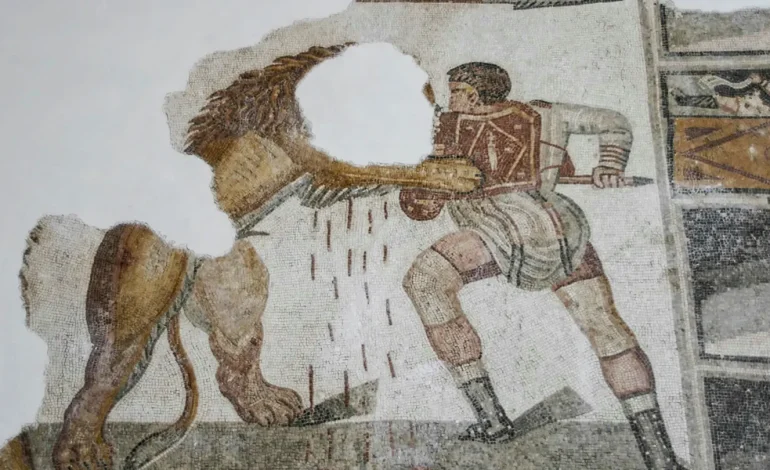

York, the picturesque city famed for its stunning medieval architecture, has yielded a startling discovery that rewrites our understanding of Roman entertainment beyond the borders of Italy, Fox News reports.
Archaeologists have unearthed the first concrete evidence of gladiatorial combat involving a lion in Roman Britain, challenging previous assumptions about the geographical extent of these brutal spectacles.
The groundbreaking findings, published in the journal PLOS One, focus on a puncture wound discovered on the pelvis of a gladiator unearthed in a York cemetery. The man, who lived during the 3rd century A.D. and was estimated to be between 26 and 35 years old at the time of his death, bore a mark that researchers have definitively identified as a bite from a large cat, most likely a lion.
“This new analysis gives us very concrete and specific evidence of a human-animal violent encounter, either as combat or punishment,” explains John Pearce, a Roman archaeologist at King’s College London and co-author of the study. “Showing that the big cats caught in North Africa were shown and fought not only in Rome or Italy but also surprisingly widely, even if we don’t know how frequently.”
Until now, archaeologists largely relied on Roman art and literature to understand the prevalence of gladiatorial contests with lions. This discovery provides tangible proof that such events, previously believed to be largely confined to Italy, occurred in the Roman province of Britannia.
The Roman city of Eboracum, founded in 71 A.D. in what is now York, was a significant military and administrative center. While archaeologists knew of Roman presence, the idea that lions were brought to this northern outpost for gladiatorial games was largely speculative.
Researchers believe the gladiator likely died in battle, although the pelvic puncture may not have been the fatal blow. Pearce suggested to Reuters that the lion may have been deliberately starved before the fight to heighten its aggression.



The latest news in your social feeds
Subscribe to our social media platforms to stay tuned