

Saudi Arabia’s Next Big Export Might Be Compute, Not Crude

With input from the New York Times, CNBC, and Reuters.
Saudi Arabia is quietly recasting itself from oil superpower to AI infrastructure heavyweight, and the pitch is simple: power is cheap here, land is plentiful, and data travels better than electricity.
That’s how Groq co-founder and CEO Jonathan Ross framed it on the sidelines of the Future Investment Initiative in Riyadh. Energy is hard and expensive to move, he argued; data isn’t.
“Since there’s plenty of excess energy in the Kingdom, the idea is move the data here, put the compute here, do the computation for AI here, and send the results,” Ross said.
Building giant data centers where the juice is abundant — and the real estate isn’t bidding against apartment towers — makes basic economic sense.
“You don’t want to build a data center right next to people, where it’s expensive for the land, or where the energy is already being used,” he added. “That’s the Middle East.”
It dovetails neatly with Vision 2030, the crown prince’s master plan to diversify beyond hydrocarbons. The government has been rolling out AI as a national priority — funding data centers, courting chipmakers, and seeding local model development — while a cluster of state-backed firms races to turn the Kingdom into a regional compute hub. One of those, Humain, says it wants to be the world’s No. 3 AI provider behind the US and China. PwC thinks the broader Middle East could reap roughly $320 billion from AI over the coming years; its forecasts put AI’s contribution at about $135 billion to Saudi GDP and $96 billion to the UAE by 2030, a reminder that Riyadh still faces fierce competition from Abu Dhabi, which moved early on chips, cloud, and marquee partnerships.
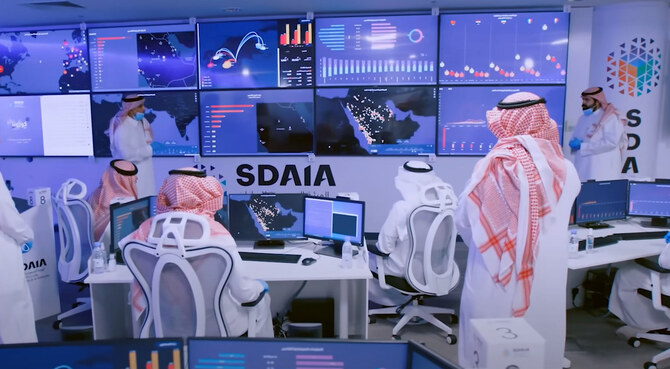
Groq is already in the mix. The company is working with Aramco Digital on what it calls the “world’s largest inferencing data center,” powered by Groq’s inference-first chips built in upstate New York. Saudi money is flowing the other direction too: the kingdom has committed $1.5 billion to help Groq scale, and the company is helping the Saudi Data and AI Authority stand up a locally tuned large language model meant to answer Saudi-specific queries better than generic, English-centric systems.
None of this glosses over the practical realities of running hyperscale compute in a desert. Data centers run hot and love water; Saudi Arabia is hot and arid. Operators are leaning into alternatives — closed-loop or seawater-assisted cooling, siting near the coasts, and better heat reuse — to square the circle. There’s also the people problem: the region has a long-running shortage of advanced digital talent. The government is leaning hard on upskilling programs and incentives to lure foreign experts while training locals. It’s a long game.
Geopolitics lurks in the background. Advanced AI semiconductors are scarce, export-controlled, and central to Washington’s effort to keep sensitive tech out of Beijing’s orbit. Saudi officials have courted US giants from Nvidia to Google while signaling they’ll buy from multiple vendors and build big, fast. The idea is to stand up several massive campuses — multi-billion-dollar complexes on both coasts with undersea cable access to Europe, Africa, and Asia — and push total capacity into the multi-gigawatt range over the next decade. To soothe jurisdictional worries, officials have even floated “data embassy” zones where foreign firms could operate under their own national laws.
Skeptics note the ambition outpaces today’s capacity and warn about a global compute glut if buildouts overshoot demand. Supporters counter that the economics are shifting in Saudi Arabia’s favor: cheap power, quick permits, deep pockets, and a growing queue of customers who just want reliable, affordable GPU hours. In that equation, the kingdom’s biggest asset is the same one that built its fortune — energy — only now it’s being converted into something far more ethereal: AI time.
If the bet pays off, Saudi Arabia won’t just export barrels. It’ll export answers.



The latest news in your social feeds
Subscribe to our social media platforms to stay tuned