

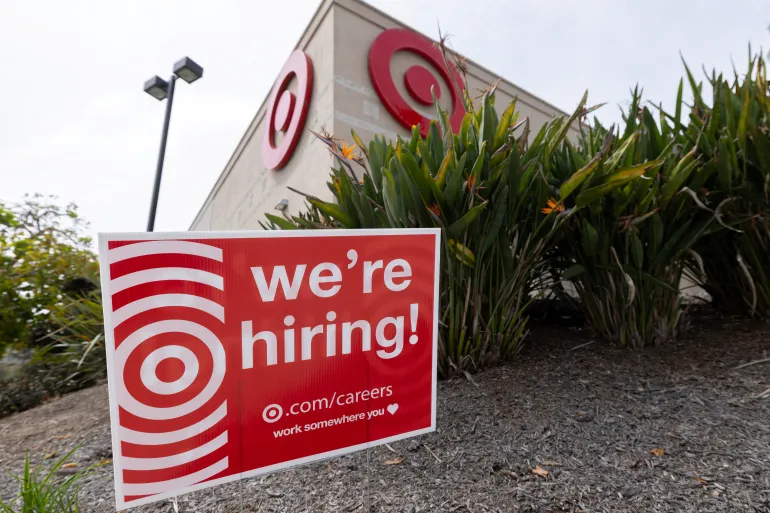



The US job market is not collapsing, but it is clearly tightening. Recent Labour Department data shows job openings falling to 6.882 million in February, the lowest level in six years, alongside a drop in hiring to levels not seen since the early pandemic. Fewer people are quitting, and consumer sentiment is sliding. Taken together, the signal is not panic, but caution.
For new graduates, that distinction matters. The market is still functioning, but it is less forgiving. Companies are hiring, just more selectively, and often with different criteria than even a few years ago. That shift is where the real story sits.
Dr. Mike Hudy, Chief Science Officer at HireVue, describes it as a recalibration rather than a downturn.
“The job outlook for college graduates this year reflects a shift toward a more cautious and uneven global market. The United States shows modest stabilization and a sense of fragile optimism, with employers forecasting a 1.6% hiring increase for the Class of 2026 versus 2025. These changes signal a recalibration with organizations now balancing budgetary caution and long-term talent needs in an environment shaped increasingly by economic uncertainty, the changing nature of work, and high applicant volumes,” he told the Wyoming Star.
That “high applicant volume” is doing as much to reshape hiring as the macroeconomics. When fewer roles attract more candidates, the bottleneck moves to screening. And increasingly, that is where AI is stepping in.
Hudy notes that much of the hiring process now begins long before a human conversation.
“Many companies are adopting AI in the hiring process (as well as across all business processes) to improve productivity, automate manual tasks, enhance efficiency and deliver faster process turnaround.”
The practical effect is that candidates are often evaluated first by systems designed to identify patterns, not personalities.
“Most of this happens early in the process, where AI can efficiently sift large applicant pools, match key skills to job requirements, and help identify strong potential fits. For example, resume screening, candidate communications and skill assessment tests. This is where AI can actually be an advantage to you, if you are effectively highlighting your skills.”
But that advantage cuts both ways. In a tighter market, weak signals get filtered out faster.
At the same time, the criteria themselves are shifting. The slowdown in hiring has coincided with a broader move away from credentials and toward capability. Employers are less focused on where a candidate studied and more on what they can actually do.
“Many companies are adopting skills based hiring approaches, such as job simulations and skill-specific assessments, to validate candidates’ actual skills vs. relying on self reported skills on resumes,” Hudy explained.
That shift is partly structural. As economic uncertainty rises, driven by factors ranging from trade tensions and immigration policy to energy shocks linked to the Iran war, companies are under pressure to reduce hiring risk. Testing real-world ability is one way to do that.
It also changes the entry point for graduates. Less experience is no longer automatically a disadvantage, but only if candidates can demonstrate practical competence.
“Skills assessments are a great opportunity for new grads, and those early in their career, who have less experience to tout on a resume, to highlight their ability to think critically, problem solve, multi-task, etc,” Hudy said.
The emphasis on skills also aligns with what employers are prioritising in a slower-growth environment: adaptability over specialisation, and execution over potential. Communication, teamwork, and critical thinking remain central, while digital and IT capabilities are increasingly treated as baseline requirements rather than differentiators.
Still, the most common mistake graduates make is not misunderstanding the tools, but misunderstanding the signal they need to send.
“The biggest misstep is trying to game the system,” Hudy said.
In a hiring process shaped by both algorithms and human review, shortcuts tend to collapse quickly.
“AI won’t be impressed by keyword stuffing, overly polished scripts, or gimmicks circulating on social media. These tools are designed to evaluate real, job-related behaviors, and even if someone manages to “trick” an automated screen, the illusion falls apart the moment they’re interacting with a human interviewer or doing the actual job.”
That tension between automation and authenticity is becoming central to how early careers are built. Technology is compressing the early stages of hiring, but it is also raising the bar for what counts as credible.
Hudy frames the adjustment in simple terms.
“Aim for substance, not performance. The companies using AI well are looking for real-world capabilities, not theatrics.”
For graduates entering the 2026 market, the takeaway is less about fear of AI or macroeconomic slowdown, and more about alignment. The system is not closed — but it is more selective, more structured, and less tolerant of noise.


The latest news in your social feeds
Subscribe to our social media platforms to stay tuned