



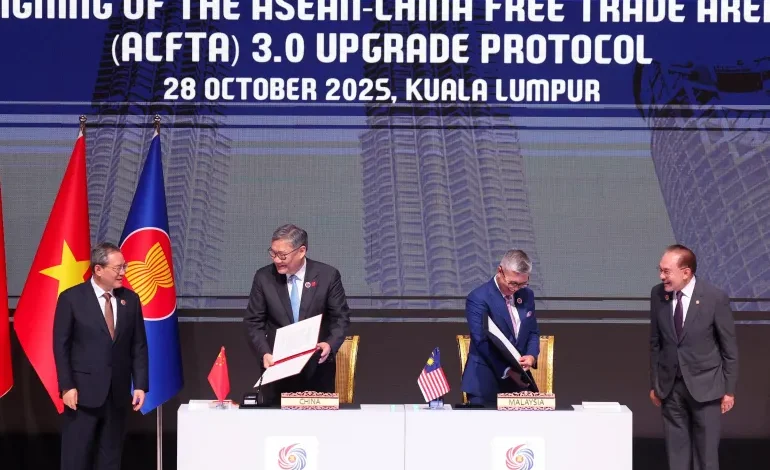

China and Southeast Asia have taken another step toward solidifying their economic bond, unveiling an upgraded free trade agreement even as Washington’s tariff wars reshape global commerce.
Signed on the sidelines of the 47th ASEAN Summit in Kuala Lumpur, the so-called “3.0 version” of the China-ASEAN Free Trade Area marks a deepening of what has become one of the world’s most vital trade corridors. Witnessed by Chinese Premier Li Qiang and Malaysian Prime Minister Anwar Ibrahim, the pact expands cooperation into new arenas, from infrastructure and digital trade to green energy and logistics.
Beijing’s State Council described the upgraded deal as a platform for “higher-quality economic cooperation,” a phrase that underscores China’s ambition to secure resilient partnerships as its relationships with the United States and Europe deteriorate.
Li praised the progress between Beijing and the 11-member bloc, noting that “cooperation in various fields has yielded fruitful results, trade volume continues to grow steadily, and ASEAN governments have promoted even closer people-to-people exchanges.”
Trade between China and ASEAN hit $785 billion in the first nine months of 2025, up nearly 10 percent year-on-year, as the region’s “China Plus One” supply chains matured in the wake of Trump’s 2018 trade war. What began as an effort by manufacturers to hedge against tariffs has evolved into a structural shift in global trade: ASEAN has now overtaken the US and EU as China’s largest trading partner.
Li also used the platform to deliver a veiled critique of Trump’s tariff policies, calling unilateralism “a serious disruption to the global economic and trade order.” His comments echoed a growing sentiment in Asia that Washington’s protectionist turn is reshaping, and in some cases accelerating, regional integration.
Ironically, Trump himself was also in attendance at the Kuala Lumpur summit, announcing new bilateral trade deals with Cambodia and Malaysia, as well as framework agreements with Thailand and Vietnam. The US president’s “reciprocal tariff” policy, under which trading partners face a standard rate of roughly 19 to 20 percent, has driven Southeast Asian states to hedge their bets by deepening ties with Beijing even as they maintain pragmatic relations with Washington.
Later this week, Trump and Chinese President Xi Jinping are expected to meet in South Korea for their first face-to-face encounter since 2019. The summit is likely to revolve around tariffs, after US Treasury Secretary Scott Bessent said both sides had reached a “framework agreement” meant to forestall Trump’s threat of 100 percent duties on Chinese goods.


The latest news in your social feeds
Subscribe to our social media platforms to stay tuned