




Wyoming eyes risks to Miracle Mile as Seminoe pumped-storage project awaits decision
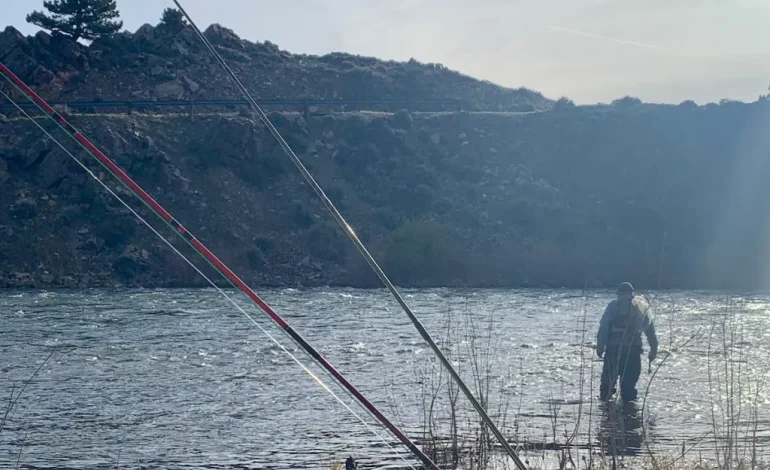

A proposed hydroelectric project near one of Wyoming’s most famous fishing stretches has state regulators walking a tightrope between energy development and protecting a trout fishery many anglers consider untouchable.
The project would sit just upstream of the Miracle Mile, a celebrated stretch of the North Platte River in south-central Wyoming that state officials describe as having major ecological, social and economic value. For anglers, it’s even simpler: there’s nothing else like it.
The Wyoming Department of Environmental Quality is now deciding whether to sign off on a key water quality permit for Black Canyon Hydro, which wants to build a massive pumped-water storage facility near Seminoe Reservoir. The concern? That cycling water through the system could cloud the river and warm it up — two things trout don’t handle well.
Once known as a Class 1 water, the Miracle Mile is now officially designated an “outstanding resource water,” the highest level of protection Wyoming offers.
“These waters receive the highest level of water quality protection, and no further degradation from human activity is allowed,” DEQ Water Quality Division Administrator Jennifer Zygmunt said during a live-streamed public hearing this week.
That designation sets an extremely high bar for the project. DEQ is reviewing Black Canyon’s application for a Section 401 water quality certification, which gives the state leverage to impose strict conditions — or deny approval altogether.
Rather than rejecting the permit outright, DEQ officials say their goal is to lock in detailed water-quality limits and early-warning “triggers” that would force the company to change operations before damage occurs.
“These thresholds and triggers are preventative,” Zygmunt said. “They would kick in before there’s an exceedance of our water quality standards, not after.”
But for many who fish the Miracle Mile, that reassurance doesn’t go far enough.
Laramie resident Douglas Miller told regulators that modeling and mitigation plans can’t truly account for real-world failures.
“I don’t think there are any mitigations that can adequately reduce the risk of something bad happening,” Miller said. “This project just presents an unacceptable risk to this one-of-a-kind resource.”
Public comment on the permit closes Monday at 5 p.m.
The proposal has drawn criticism from local and national outdoor groups, along with formal opposition from the Casper City Council and officials in Natrona and Carbon counties. Critics argue the project could harm not only trout and aquatic life, but also key habitat for elk, mule deer, sage grouse and a sensitive bighorn sheep herd.
DEQ officials stress their authority is limited to water quality impacts tied to the 401 certification. The broader project review falls under the Federal Energy Regulatory Commission, which will ultimately decide whether the project moves forward.
A ‘water battery’ above Seminoe
Black Canyon Hydro — a subsidiary of Utah-based rPlus Hydro — wants to build a 13,400-acre-foot reservoir in the Bennett Mountains above Seminoe Reservoir, one of several reservoirs on the North Platte River.
The concept is simple in theory: pump water uphill from Seminoe when electricity is cheap, then release it back downhill through turbines when demand spikes.
Company officials describe the $3 billion to $5 billion project as a “water battery” — storing energy when it’s plentiful and releasing it when the grid needs it most.
Construction could take around five years, largely due to wildlife protections that restrict when work can happen. Black Canyon has asked regulators to waive many of those timing limits, a move that has alarmed wildlife advocates and the Wyoming Game and Fish Department.
Can modeling predict the future?
DEQ has spent nearly two years working with Black Canyon and stakeholders like Trout Unlimited to refine water-quality modeling and draft permit conditions meant to protect the river.
Still, critics say the plan doesn’t fully account for drought, climate change, or worst-case scenarios — exactly the kinds of stresses that could push the Miracle Mile past its breaking point.
For now, the fate of both the project and one of Wyoming’s most treasured fisheries rests on whether regulators believe safeguards on paper can truly protect a river that many say shouldn’t be tested at all.


The latest news in your social feeds
Subscribe to our social media platforms to stay tuned