

Hezbollah vows resistance after Khamenei killing but Lebanon’s state pushes back

Hezbollah has responded to the killing of Iran’s Supreme Leader Ayatollah Ali Khamenei with a familiar mix of ideological loyalty and strategic restraint, signalling commitment to confrontation while stopping short of immediate military action.
In a statement issued on Sunday, the Iran-aligned movement framed the joint US-Israeli strike that killed Khamenei and other senior Iranian figures as a defining moment.
“That the criminal American and Zionist [Israeli] aggression targeted our guardian, our leader, the leader of the Nation, Imam Khamenei (may his soul be sanctified), along with a group of leaders, officials, and innocent sons of the Iranian people, represents the height of criminality,” the group said.
The language left little ambiguity about where Hezbollah places itself in the widening regional conflict. “We will fulfill our duty in confronting aggression, confident in Allah’s victory, guidance, and support… No matter how great the sacrifices, we will not abandon the field of honour and resistance, nor the confrontation against American tyranny and Zionist criminality, in defence of our land, our dignity, and our independent choices,” it added.
Yet on the ground, the organisation has not opened a new front. Since the strikes on Iran began, there has been no direct action against Israeli or US targets from Lebanese territory. That pause reflects a different reality inside Lebanon, where the state — weakened but still wary of another war — has moved quickly to assert its authority over the decision to fight.
President Joseph Aoun stated after an emergency meeting of the Higher Defence Council that “the decision of war and peace rests solely with the Lebanese state”. Prime Minister Nawaf Salam struck a similar tone, saying he would not accept anyone “dragging the country into adventures that threaten its security and unity”. He urged citizens to act “with wisdom and patriotism, placing Lebanon and the Lebanese people’s interests above any other consideration”.
Those statements underline the tension between Hezbollah’s regional role and Lebanon’s domestic fragility. The country is still trying to stabilise after a yearlong war with Israel that ended in a ceasefire in November 2024. That agreement has remained shaky, with Israel continuing to carry out strikes and maintaining several positions inside Lebanese territory, keeping the border in a state of low-level confrontation.
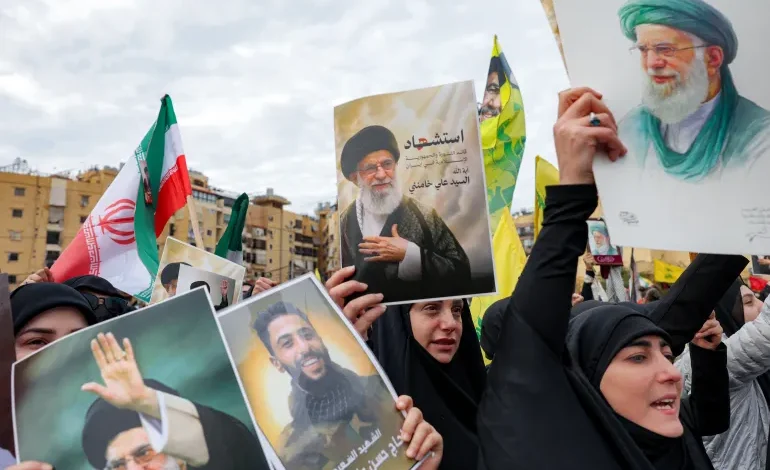
At the same time, Hezbollah has moved to demonstrate that its political and social base remains intact. Thousands gathered in Beirut on Sunday for a mass mourning ceremony for Khamenei, chanting “Death to America, death to Israel”. For supporters, the moment carried echoes of the killing of the group’s own leader last year.
“It felt just like the martyrdom of the Sayyed,” said Zainab al-Moussawi, referring to Hassan Nasrallah.
The group has also called for coordinated religious observances in areas where it holds influence, embedding Khamenei’s death in the symbolic language of resistance rather than treating it solely as a geopolitical loss.

The latest news in your social feeds
Subscribe to our social media platforms to stay tuned