

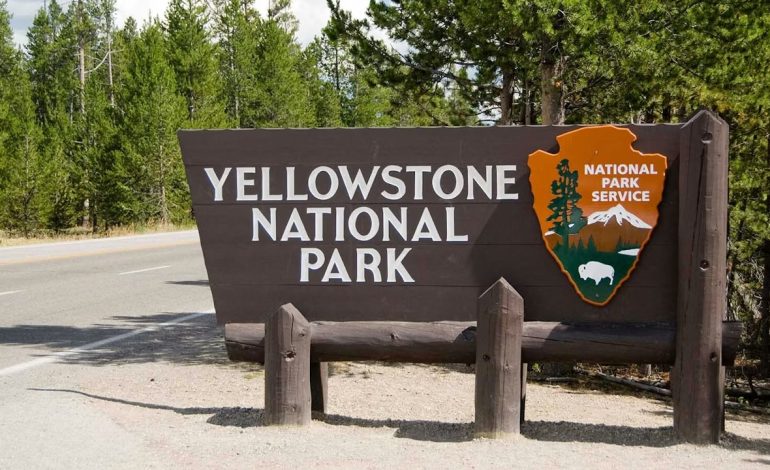

An Oregon man accused of violating Yellowstone National Park’s fishing restrictions and a road closure is challenging the park’s rules as unenforceable under the U.S. Constitution. Tate Pulliam filed a motion to dismiss his citations Monday in the U.S. District Court for Wyoming, asking Magistrate Judge Stephanie Hambrick to dismiss three citations he faces as government overreach. A win by Pulliam on that argument could upend Yellowstone National Park’s ability to enforce rules not specifically contoured by Congress.
Pulliam’s advocacy team, Pacific Legal Foundation, hinges its argument on the U.S. Constitution’s language about how the federal government can appoint officials, as well as on language limiting lawmaking power to Congress. “Tate went to Yellowstone to enjoy public land and left facing criminal charges,” said Pacific Legal Foundation attorney Michael Poon in a Monday statement. “But Congress never made his alleged actions illegal. Instead, a park superintendent invented the rules behind these charges, resulting in massive overcriminalization. That is not how lawmaking works under the Constitution.”
Pulliam was cited in December on claims he was fishing in a river that was closed to fishermen for the winter, fishing without the proper permit, and driving his truck over a road then open only to over-snow vehicles. The statement says Pulliam faces up to 18 months in prison. “Pulliam is fighting back against charges that never should have been filed,” says Pacific Legal Foundation’s statement. “The Constitution requires Congress to decide what conduct is criminal, including in national parks, but Congress improperly handed that sweeping power over to the Executive Branch.”
Darin Smith, U.S. Attorney for Wyoming, told Cowboy State Daily that his office is preparing a response to Pulliam’s motion. The government disagrees with Pulliam’s arguments for dismissal and believes Yellowstone National Park Superintendent Cam Sholly acted within his proper authority, he said.
Hambrick rejected some arguments matching Pulliam’s last year in the case of trail runner Michelino Sunseri, who set a new Grand Teton trail running speed record in September 2024 and was later charged with a crime for running on a “restricted” social trail. Hambrick convicted Sunseri after a May 2025 bench trial. Like Pulliam, Sunseri had brought in the Pacific Legal Foundation, challenging Hambrick’s decision on roughly matching grounds. In Sunseri’s case, Hambrick was not convinced. She concluded the Grand Teton National Park superintendent is a federal employee, not a federal officer subject to the Constitution’s specific appointment procedures. She also pointed to earlier court findings that the National Park Service’s authority to craft rules is “necessary and proper to effect Congress’s stated goal of preserving and managing national parks.” Sunseri’s case didn’t find vindication or resolution in the appeals process, and President Donald Trump pardoned Sunseri last November. Hambrick, the same magistrate, is now presiding over Pulliam’s case.
Pulliam’s argument says Hambrick should abandon her earlier legal findings from Sunseri’s case. The filing touches on both the Declaration of Independence and James Madison’s “The Report of 1800.” Pulliam asserts that the Yellowstone superintendent has “clearly significant” authority and should be subject to the Constitution’s appointments process, but that his appointment didn’t follow the proper process. “Criminal punishment is one of the most severe exercises of government power, and allowing executive officials to determine which conduct constitutes a crime concentrates legislative and prosecutorial authority in the same branch — precisely the danger the separation of powers was designed to prevent,” says the filing. Pulliam’s next hearing is set for May 12 in the Yellowstone Justice Center.


The latest news in your social feeds
Subscribe to our social media platforms to stay tuned