

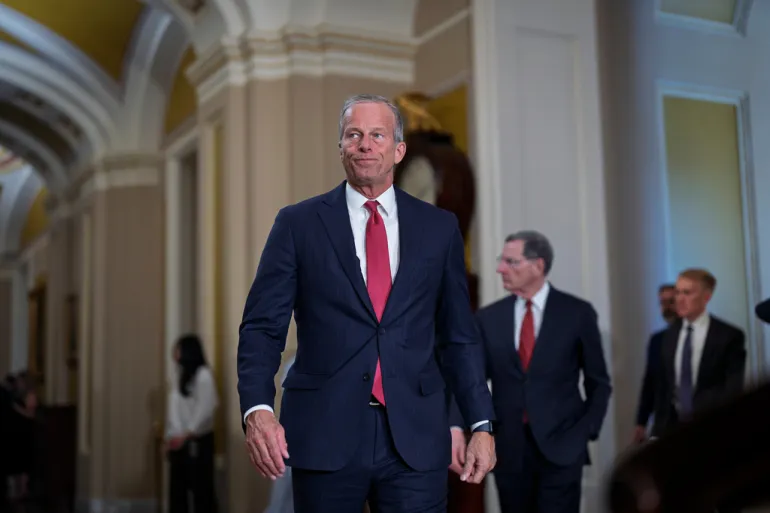




The standoff over immigration policy in Washington is entering a more procedural phase. With negotiations stalled, President Donald Trump is urging Republicans to move ahead using one of Congress’s most powerful legislative shortcuts — budget reconciliation.
In a social media post on Wednesday, Trump framed the approach as both necessary and urgent, calling on his party to close ranks behind the effort.
“Senate Majority Leader John Thune, and Senator Lindsey Graham, have taken a critical first step to passing another Reconciliation Bill to fund our Great Border Patrol and ICE [Immigration and Customs Enforcement] Agents,” Trump wrote.
“Republicans must stick together and UNIFY to get this done, and to keep America safe — something which the Democrats don’t care about.”
The appeal comes against the backdrop of a partial shutdown at the Department of Homeland Security that has stretched on since mid-February. While DHS includes a wide range of agencies — from the Transportation Security Administration to FEMA — the political fight has narrowed to two: ICE and Customs and Border Protection.
Democrats have drawn a line around those agencies, refusing additional funding unless enforcement practices are reworked. The demand follows the fatal shootings of Alex Pretti and Renee Nicole Good in January during an immigration crackdown in Minneapolis, which sharpened scrutiny of how federal agents operate on the ground.
The proposed reforms are relatively specific — clearer identification by agents and safeguards against racial profiling — but Republicans have rejected tying those conditions to funding.
That impasse is what makes reconciliation attractive. The process allows legislation tied to spending and budget targets to pass the Senate with a simple majority, bypassing the usual 60-vote threshold needed to overcome a filibuster. For a party with narrow control of both chambers, it offers a way around bipartisan deadlock, but also narrows what can be included in the bill.
The Senate has already taken the first formal step. On Tuesday, lawmakers voted 52 to 46 to begin the reconciliation process that could ultimately channel funding to ICE and CBP.
Senator Lindsey Graham cast the move as a turning point, calling it a “significant step” and signalling a broader goal: “fully fund Border Patrol and ICE for the rest of the Trump presidency!”
Republican leadership has been more restrained in tone, if not in direction.
“It’s not my preference,” Senate Majority Leader John Thune said on Tuesday. “But it is reality.”
For Democrats, the process itself is part of the problem. By shifting the fight into reconciliation, Republicans are effectively separating funding decisions from policy constraints.
Democratic Senate Minority Leader Chuck Schumer described the effort as a “partisan sideshow” that would direct money towards immigration enforcement, “without putting any restraints on these rogue agencies’ rampant violence in our streets”.
This isn’t the first time reconciliation has been used this way. Republicans relied on the same mechanism last year to pass a major tax and spending package without Democratic support, reinforcing its role as a workaround when consensus proves impossible.


The latest news in your social feeds
Subscribe to our social media platforms to stay tuned