


The war between the United States, Israel, and Iran is stuck in a strange purgatory. The bombs have largely stopped falling, but the strait that moves a fifth of the world’s oil remains shut. Diplomats have come and gone from Islamabad, yet little changed.
What began on February 28 as Operation Epic Fury – a coordinated US‑Israeli assault that killed Iran’s Supreme Leader Ali Khamenei on the first night – has turned into a grinding standoff. Four weeks of strikes and retaliation left more than 3,500 Iranians dead, including 1,600 civilians, and displaced 3.2 million inside the country. The Pentagon confirmed at least 150 American casualties in the early phase, with 13 US service members killed. Israel lost 157 soldiers in its parallel war with Hezbollah in Lebanon, and more than 2,100 Lebanese civilians and fighters died in Israeli airstrikes that flattened entire villages in the south.
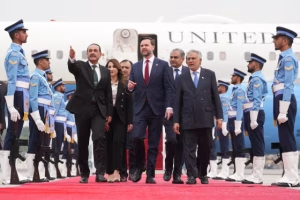
The April 7 ceasefire, brokered by Pakistan, gave everyone a breath. But two weeks of hard diplomacy in Islamabad failed to produce a deal. Vice President JD Vance and Iran’s Parliament Speaker Mohammad Bagher Ghalibaf sat across a table for 21 hours. Then the US delegation abruptly left, and the Navy imposed a naval blockade on Iranian ports. Tehran responded by closing the Strait of Hormuz again.
That was on April 13. The two‑week ceasefire technically expired on April 22. But instead of letting it die, President Trump extended it indefinitely. He kept the blockade in place. Iran kept the strait mostly closed.
The human cost of this conflict is staggering, even by Middle East standards. According to UN figures cited by the Economist’s war tracker, the direct war fatalities exceed 5,800 people across Iran, Israel, Lebanon, and Gulf states. Iranian authorities have counted 3,380 dead, but independent monitors suspect the real toll is higher, given the blackouts and collapsed healthcare that followed strikes on power grids and water treatment plants. The IRGC lost at least four senior commanders. Israel’s military says it has killed more than 1100 Hezbollah fighters, a number Hezbollah does not confirm.
Lebanon has become the forgotten front. Israeli ground forces pushed several miles across the border in early March and have stayed there. The Lebanese Army largely stands aside. On April 23, an Israeli strike killed a prominent Lebanese journalist, Amal Khalil, bringing the journalist death toll in the Israeli campaigns in the Middle East to 262.
The economic toll is less visible but just as brutal. The IMF slashed global growth forecasts by 0.2 percentage points. Oil prices remain above $100 a barrel for Brent crude, and the US Energy Information Administration estimates that 600 million barrels of supply have been lost. Developing countries are paying the price in higher food and transport costs, while the UN Development Program warned that 32 million more people could fall into poverty if the standoff continues through the summer.
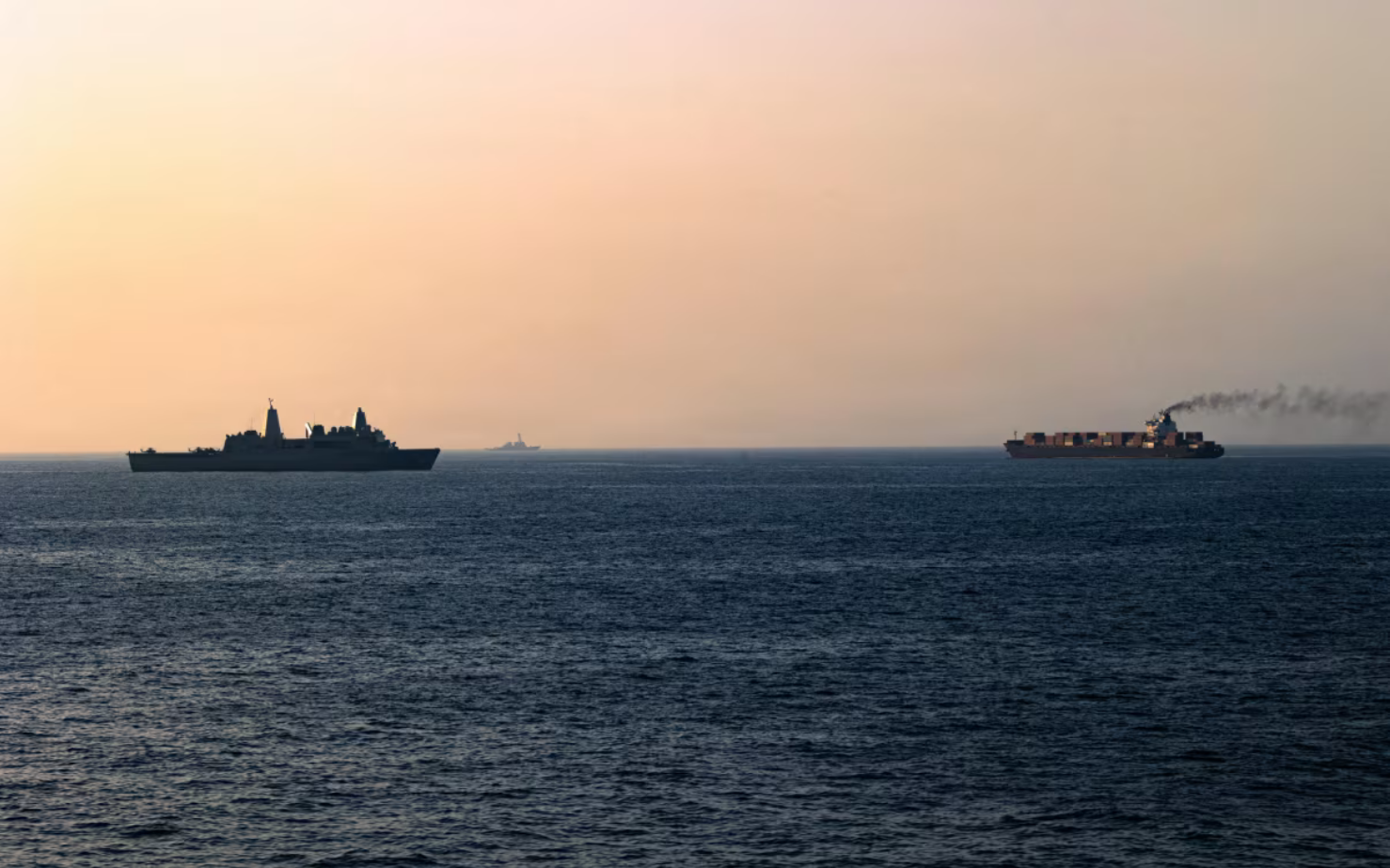
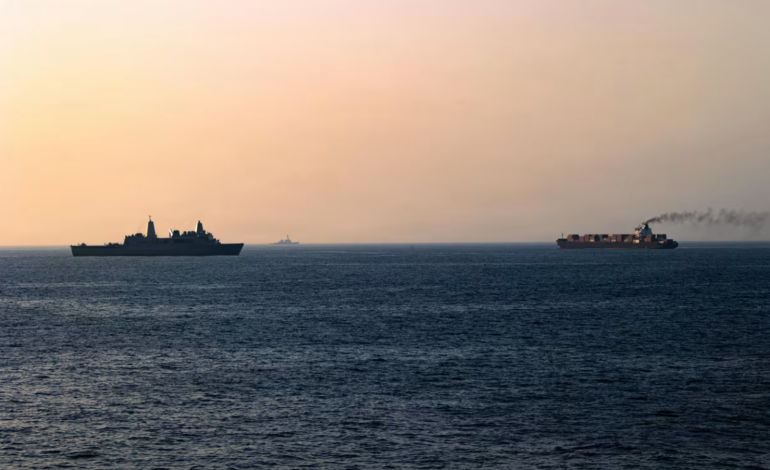
The Strait of Hormuz is only 21 miles wide at its narrowest point. Iran has deployed its fleet of small, fast attack boats – known as “swarm boats” – that dart around any tanker trying to move. The US Navy has stationed destroyers at both ends of the strait and has seized at least one Iranian‑flagged cargo ship since the blockade began. Iran, in turn, has seized three vessels it accuses of violating its territorial waters.
Traffic has slowed to a crawl. On April 24, Reuters reported that only five ships passed through the strait in the previous 24 hours. Before the war, the average was 138 per day. The Dow Chemical CEO told CNBC that clearing the logjam, even if a deal is reached tomorrow, would take “almost a year” because of damaged infrastructure and the need to re-inspect every vessel.
Iran’s message is consistent: no talks until the US lifts the blockade. The US position is equally rigid: no lifting the blockade until Iran agrees to verifiable limits on its nuclear program and opens the strait to all shipping. Each side accuses the other of piracy. Iran’s Foreign Ministry called the US ship seizure “armed robbery.” The Pentagon called Iran’s interdictions “acts of war.”
Trump has tried to paint the indefinite ceasefire as a victory. On April 21, he told reporters:
“We have the strait exactly where we want it. Iran is suffering. They’ll come back to the table.”
But the evidence suggests otherwise. Iran’s Supreme Leader Ayatollah Ali Khamenei’s successor, who has consolidated power during the war, has shown no willingness to capitulate. The IRGC’s morale, by most accounts, remains high, and its drone and missile factories are still operating, albeit at reduced capacity.
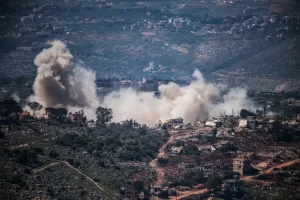
Israel and Lebanon held direct talks in Washington on April 16 and 17 – the first such high‑level meeting in decades. The US mediated a separate 10‑day ceasefire for the Lebanese front, but it has been violated almost every day. Hezbollah launched a drone strike on an Israeli army position in southern Lebanon on April 23, and Israel responded with artillery and airstrikes that killed two more civilians. The April 22 talks lead to another ceasefire again announced by Trump.
The core issue is disarmament. Israel demands that Hezbollah withdraw north of the Litani River and hand over its heavy weapons to the Lebanese Army. Hezbollah refuses. Lebanon’s fractured political class is terrified of sparking a civil war. A senior Lebanese official told Al Jazeera that the government “cannot and will not” forcibly disarm Hezbollah. The US has not pushed hard, distracted by the wider confrontation with Iran.
Analysts warn that the Lebanon track is a poison pill for any broader Iran deal. Tehran has made clear that it will not accept a final agreement that leaves Hezbollah exposed. And Israel has made equally clear that it will not accept an agreement that leaves Hezbollah intact. The US is caught in the middle.
No second round of talks has been scheduled. Pakistan, which hosted the first round, has maintained a security lockdown in Islamabad but admitted that no new date has been set. The US State Department says it remains “ready to engage” but will not lift the blockade as a precondition.
Seyed Hossein Mousavian, a Visiting Research Collaborator with the Program on Science and Global Security at Princeton University and a former Iranian nuclear negotiator, offered a detailed diagnosis of the impasse:
“The negotiations are currently at a deadlock. The main reason is that both sides had agreed to a ceasefire followed by negotiations. Talks were held in Islamabad about 12 days ago. The first day of negotiations went well, and it was expected that a draft agreement would be finalized on the second day. However, the US delegation suddenly left Islamabad and immediately imposed a naval blockade on Iran. In response, Iran once again closed the Strait of Hormuz. Under international law, a naval blockade constitutes an act of war. Iran has stated that if the United States recommits to the ceasefire and lifts the naval blockade, it will reopen the Strait of Hormuz and return to negotiations. So far, Washington has not accepted these terms. As a result, Iran has continued to limit navigation in the Strait, which is why the situation remains at a deadlock.
The core problem is that US policy appears to be aimed at Iran’s capitulation. Washington needs to recognize that negotiations designed to force Iran’s surrender have neither worked in the past nor will they succeed in the future. Negotiations must be fair and mutually beneficial. Any viable agreement must allow both sides to save face, as each government needs to present the outcome as a success to its domestic audience.
While the agreement was in force, Iran fully complied with its commitments. The International Atomic Energy Agency had full oversight of Iran’s nuclear program, and in 16 reports over a period of three to four years, it consistently confirmed the peaceful nature of the program. During that time, Iran had no stockpile of highly enriched uranium. Iran also engaged in regional dialogue on Syria and Yemen with the United States, the EU, and the broader international community. When 16 US sailors accidentally entered Iranian territorial waters, direct communication between John Kerry and Mohammad Javad Zarif led to their release within 24 hours. President Trump could have built on this progress and pursued broader negotiations with Iran – what might be called a “JCPOA Plus” – to address regional issues rather than killing the deal.”
More of Dr. Mousavian’s analysis can be found here.
Kristin Diwan, a Senior Resident Scholar at the Arab Gulf States Institute, sees the standoff as a tactical pause rather than a terminal breakdown:
“We are at a standoff. By extending the ceasefire President Trump has stood down, indicating a reluctance to pursue a military escalation involving an extensive bombing campaign. Instead, both sides are moving tactically in a way to gain advantage before re-entering negotiations.
If the will is there, formulas are present to return to the table. Both sides could back off their blockades and temporarily allow traffic to resume in the Strait of Hormuz during the period of ceasefire and negotiations. They might even agree to a lesser opening, but one that allows critical supplies, such as fertilizer, to pass.
Neighboring Gulf states are already signaling a reluctant acceptance that the war will end without a decisive defeat of Iran and perhaps even leaving the country in a stronger strategic position vis-à-vis the Strait. The most hawkish state, the UAE, spoke with the Iranian Foreign Minister Araghchi and is likewise seeking monetary relations with the US which would buttress confidence on international financial markets for a longer, more inconclusive, period of prolonged threat.”
David Mednicoff, Associate Professor of Middle Eastern Studies and Public Policy at the University of Massachusetts-Amherst, focuses on the role of Trump:
“President Trump continues to be in a dilemma of his own making by believing that he could start and finish a war with Iran that could lead to a major change in Iran’s politics and global priorities through large bombing campaigns. The dilemma is that, on the one hand, the President wants to show that he extracted significantly and tangibly more from Iran than had been achieved under the multilateral diplomatic agreement he scuttled that his predecessor, President Obama, had negotiated. Yet, on the other hand, Iran’s hard-line military leaders appear in no rush to negotiate, knowing that the U.S. is likely to commit to a major ground war and is hurting, along with much of the rest of the world, from the ongoing conflict, particularly with Iran’s newly won control over most of the Strait of Hormuz. Meanwhile, the third major party to the war, Israel, has a government that benefits more from, and favors, ongoing war against Hizballah and Iran than it does from peace.
This means that President Trump is the most eager of the three parties to end the war, giving Iran some capacity to delay in the hopes that the war’s domestic American unpopularity and global economic costs lead President Trump to concede more in an agreement. Iranians don’t want unending war any more than do most Americans or Israelis, but Iran’s government’s relative insensitivity to popular demands and the fact that the war is existential for that government make it more likely that Iranian leaders will press to consolidate their current negotiating advantage for now.”
Stephen Zunes, a Professor of Politics and International Studies at the University of San Francisco and a longtime analyst of US policy and nonviolent movements, offered a bleak long‑view:
“It’s hard to see an end to the conflict any time soon. Hopefully, both sides now recognize they cannot achieve their aims through full-scale war, but the positions of the two sides appear to be as far apart as ever. The fact that Trump is continually contradicting himself makes things even harder to predict. The best-case scenario at this point is that Iran would agree to end its blocking of shipping to the Arab Gulf states in return for the United States ending their blockade of Iran and leaving the other issues for later. The most likely scenario, however, involves a long drawn-out conflict, with both sides jockeying for control of the Strait of Hormuz while the global economy worsens.
The 2015 nuclear agreement made it impossible for Iran to develop a nuclear weapon. Despite this, two years later, Trump ended up reneging on sanctions relief, so the Iranians resumed uranium reprocessing to a much higher degree than the treaty allowed. Trump still insists he can do a better deal than Obama. However, the original nuclear agreement was a result of two years of intense, painstaking negotiations using the United States’ most experienced diplomats, mediators, and technical experts. It also included negotiators from Great Britain, France, Germany, China, Russia, the European Union, and the United Nations. For Trump to assume that he can simply send his son-in-law Jared Kushner, his real estate buddy Steve Witkoff, and his inexperienced vice-president J.D. Vance to Pakistan for a day or so and negotiate a new and better agreement is ludicrous, particularly given the Iranians’ understandable lack of trust in the United States.
There are certainly many in Lebanon who would agree with Israel that Hezbollah should be disarmed. However, the corrupt and inept Lebanese government is unlikely to risk a civil war to do so. Israel has proven repeatedly that they can’t destroy Hezbollah either.
It’s ironic that Israel is now occupying southern Lebanon on the grounds that they must defeat Hezbollah when Hezbollah was formed as a direct result of Israel’s earlier occupation of southern Lebanon in the 1980s.”
While the ceasefire holds, both sides have spent the past weeks digging in. The US military is reportedly considering firing at Iranian mining vessels – a move that would guarantee a resumption of full‑scale war. Iran has threatened to hit US bases in the Gulf if that happens.
The diplomatic path is still there, but it requires a fundamental shift in US posture. A deal that humiliates Iran is no deal at all. The Gulf states are already preparing for a world where Iran retains control of the strait. That world would look very different from the one Trump promised when he launched the war.


The latest news in your social feeds
Subscribe to our social media platforms to stay tuned