
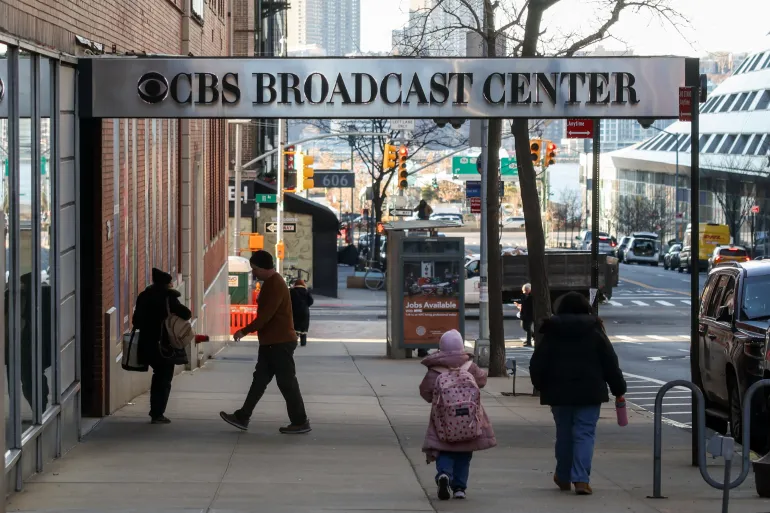




A shareholder vote this week could mark a turning point for the US media industry, as Warner Bros Discovery moves closer to merging with Paramount Skydance — a deal that would bring CNN and CBS News under the same corporate umbrella.
The proposal still faces regulatory approval, but even at this stage, it is already raising questions that go beyond market share. At stake is not just consolidation, but how editorial direction might shift when two major newsrooms fall under a single ownership structure.
Paramount Skydance is led by David Ellison, whose proximity to Donald Trump has drawn attention in itself. Under his leadership, critics argue, CBS has already shown signs of editorial repositioning.
Those concerns are rooted in specific decisions. Bari Weiss, a conservative opinion writer without television experience, was brought in to lead the network. Ken Weinstein, a former Trump administration appointee, was installed as an ombudsman to monitor bias. At the same time, some reporting seen as critical of the administration has reportedly been delayed or dropped altogether.
That includes a story on CECOT, the El Salvador prison linked to US deportations, which correspondent Sharyn Alfonsi described as a “political” decision.
Ellison has tried to calm fears, saying editorial independence “needs to be maintained” and pointing to CBS as an example. But that reassurance has not landed cleanly.
“Ellison has already shown his cards when it comes to editorial independence and has zero credibility on the issue,” Seth Stern, director of advocacy at the Freedom of the Press Foundation, told Al Jazeera.
“Ellison may not turn CNN into Fox News overnight and may even still let CNN reporters criticise Trump at times. But it’s a virtual certainty that when his business interests are at stake, Trump will be given a seat at the editor’s desk.”
If the merger goes through, those questions will extend to CNN — a network that has long positioned itself as relatively centrist but has been a frequent target of Trump’s criticism. Reports that Ellison has promised “sweeping changes” have added to unease inside the organisation, where staff are said to be unsettled by the prospect of new leadership.
The political dimension doesn’t stop at editorial concerns. The deal has also triggered scrutiny in Washington and abroad. Senator Cory Booker has called for an investigation into foreign investment tied to the merger, which includes funding from Gulf sovereign wealth funds and China. In the UK, regulators are preparing their own review.
Even before any merger is finalised, there are signs of internal strain. Some longtime CBS journalists have already left, citing dissatisfaction with the network’s direction, while cost-cutting moves — including the shutdown of CBS News Radio — suggest broader restructuring underway.
What makes this moment more consequential is that it doesn’t exist in isolation. A parallel consolidation is unfolding in local news, where companies like Nexstar and Tegna are moving toward a merger that could extend their reach across roughly 80 percent of US TV households.
Historically, local affiliates operated with a degree of separation from national political narratives. They produced their own content while licensing network programming, maintaining a focus on local audiences. That model is still in place structurally, but its editorial neutrality has started to shift.
Sinclair Broadcast Group provided an early example, drawing backlash in 2018 for pushing uniform, pro-Trump messaging across dozens of stations. Now, similar concerns are emerging around other operators, including Nexstar, whose cable network NewsNation has reportedly been trending right.
Taken together, these developments point to a broader pattern. Ownership concentration is increasing, and with it, the potential for editorial alignment — whether intentional or structural.


The latest news in your social feeds
Subscribe to our social media platforms to stay tuned