



Japan is moving to tighten its economic and strategic relationship with Vietnam, with a new focus on energy security and critical mineral supply chains as global tensions continue to reshape trade flows.
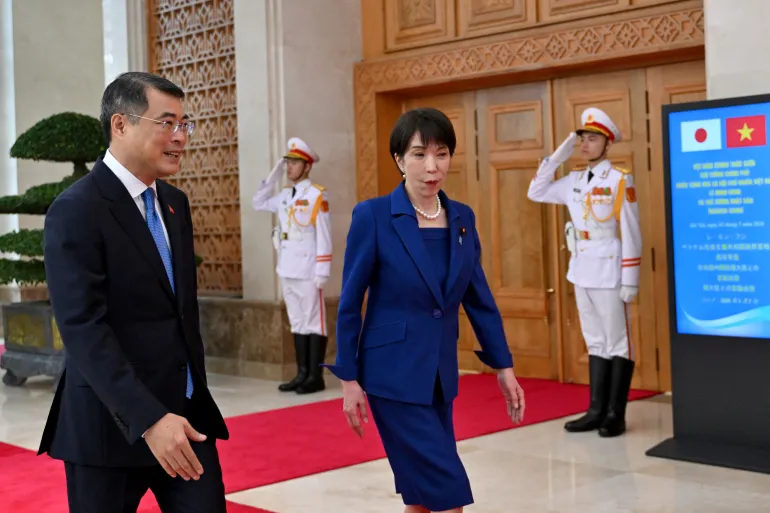
Prime Minister Sanae Takaichi and her Vietnamese counterpart Le Minh Hung met in Hanoi on Saturday, signing six agreements that span infrastructure, agriculture and even space cooperation. But the core message of the visit was about something more structural: resilience.
“The two sides identified economic security as a new priority area for bilateral cooperation,” Takaichi said after the talks.
That shift reflects how both countries are recalibrating in response to a more fragmented global environment. Supply chains that once relied on predictable flows are now exposed to geopolitical shocks, from trade tensions to disruptions linked to the war in the Middle East.
“With regard to critical minerals … both sides agreed to strengthen close coordination to ensure stable supplies and reinforce supply chains,” Takaichi added.
Those minerals — essential for everything from electronics to electric vehicles — have become a strategic priority across Asia, particularly as countries look to reduce dependence on dominant suppliers and build more diversified networks.
For Vietnam, the partnership also has a more immediate dimension: energy. Rising oil prices and supply uncertainty tied to the Middle East conflict have pushed Hanoi to seek more stable access to crude.
Under Japan’s $10bn Power Asia Initiative, Tokyo will help arrange oil supplies for Vietnam’s Nghi Son Refinery, a key industrial asset. The move positions Japan not just as an investor, but as a partner in managing energy risk.
Hung made clear the broader strategic alignment extends beyond economics.
The two sides “reaffirmed the importance of resolving disputes in the South China Sea through peaceful means based on international law”, he said — a pointed reference to ongoing tensions with China.
That overlap is not accidental. Both Japan and Vietnam have been navigating a delicate balance: strengthening regional ties while hedging against uncertainty in relations with larger powers, including both China and the United States.
The economic data behind the partnership shows a mixed picture. Japanese investment in Vietnam dropped sharply in early 2026, even as trade between the two countries continued to grow. That divergence suggests companies are cautious about committing capital, even as demand and exchange remain strong.
In that context, government-led agreements take on added importance. They provide a framework for cooperation at a time when private investment is adjusting to a more volatile landscape.



The latest news in your social feeds
Subscribe to our social media platforms to stay tuned