






Reuters, the Wall Street Journal, CNBC, CNN, the Financial Times, Investor’s Business Daily, and Axios contributed to this report.
Washington is betting big on quantum.
The Trump administration said Thursday it will take equity stakes in nine quantum-computing companies, backing them with about $2 billion in CHIPS Act money. IBM is getting the biggest piece, and the message is pretty clear: the US wants to lock down leadership in a technology it sees as strategically important, especially with China in the mix.
IBM alone will receive $1 billion to set up a new company called Anderon, which will focus on making quantum chips. IBM says the new operation will be based in New Albany, New York, and become the country’s first dedicated quantum chip manufacturing facility. The company is putting in another $1 billion of its own and says more investors are expected to come in later.
IBM CEO Arvind Krishna said the new chipmaking setup will not be a walled garden. Outside customers will be able to use the same technology IBM uses internally, and the company is already talking to potential clients.
GlobalFoundries is also in the mix, set to receive $375 million to build a US factory making components for quantum machines. Other publicly traded names, including D-Wave, Rigetti, and Infleqtion, are each slated to get around $100 million. Diraq will get up to $38 million.
The stock market liked the news. Shares of the companies tied to the deal jumped sharply, with some names climbing more than 30%.
This is not just about one industry getting a government boost. It is also another sign that Washington is willing to take direct stakes in strategic sectors, not just hand out grants and hope for the best. The logic is simple enough: protect supply chains, build domestic capacity, and stop falling behind rivals.
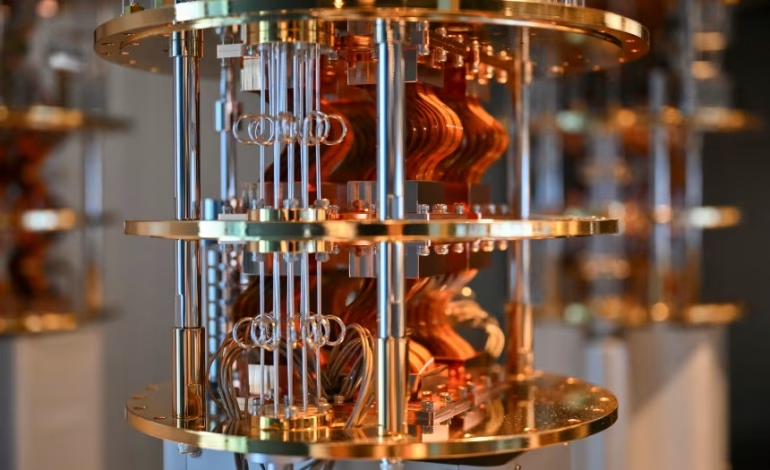
Quantum computing has plenty of hype around it, and for good reason. If it works at scale, it could be a huge deal for drug discovery, finance, cryptography and a lot more. But the tech is still messy, and the engineering hurdles are real. The qubits are fragile, errors are a problem, and practical machines are still a work in progress.
Even so, the government clearly thinks the payoff is worth the gamble. This latest move is one more sign that quantum computing is no longer being treated as a distant science project. It is being treated like a race.



The latest news in your social feeds
Subscribe to our social media platforms to stay tuned