

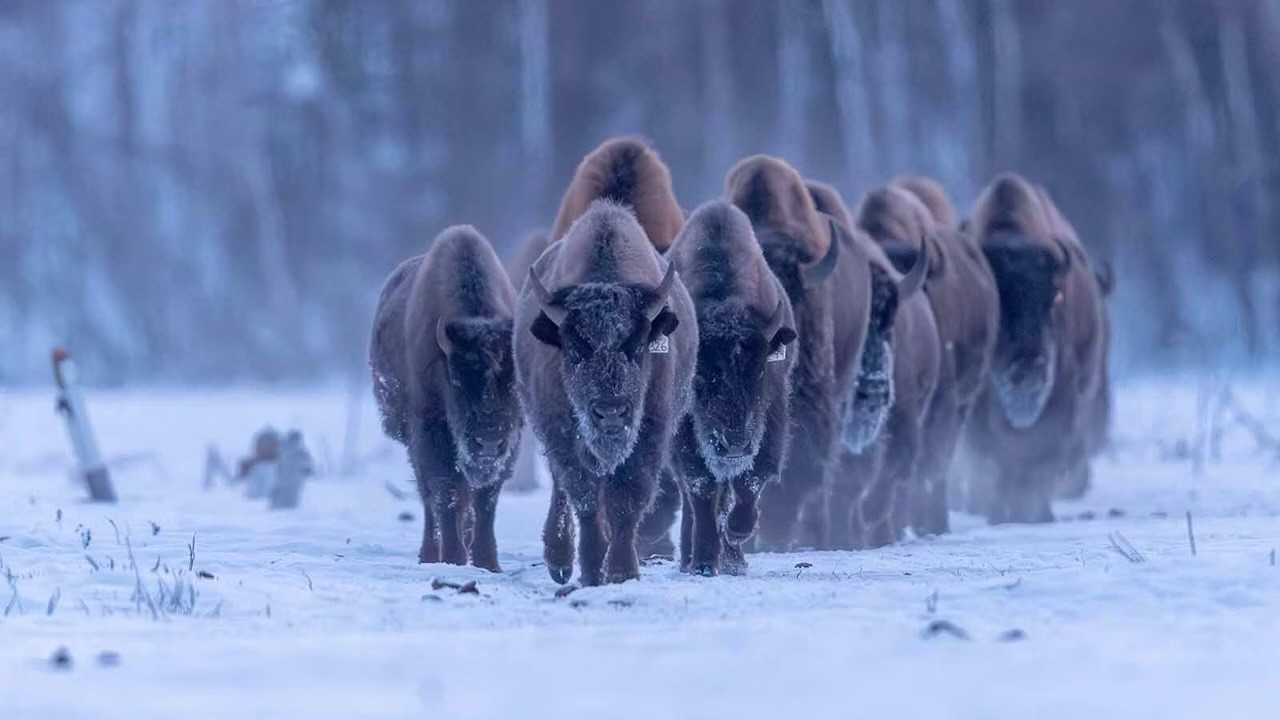



Bison might not come to mind when people think of Alaska, but wildlife officials hope to change that as they work to restore the state’s native population of wood bison. Wood bison were essentially wiped out in Alaska by the 1910s and are still listed as a threatened species. Reintroduction started in 2015 and there are now about 160 wood bison roaming wild in Alaska, with another 86 in captivity awaiting release.
Wood bison could be regarded as “those other bison” that many folks might not know about. But they’re not to be taken lightly. As massive as Wyoming’s plains bison are, wood bison are about 15% larger. While all bison are built for surviving harsh winters, wood bison are especially adapted for the worst of the worst in their native territory in northern Canada and Alaska.
There are also about 1,000 plains bison in Alaska. They aren’t native to the state, but about 20 were transplanted from Montana in the 1920s. Hunting for plains bison is allowed in Alaska, with about 150 tags issued each year, Tom Seaton, the wood bison project biologist with the Alaska Department of Fish and Game, told Cowboy State Daily. “The ultimate destination for this restoration project is to have hunting for wood bison as a renewable resource,” he said.
Wood bison are thought to have been in Canada and Alaska for at least 10,000 years. Uncontrolled overhunting might have greatly contributed to their loss. Records indicate that the last known wood bison in Alaska was shot around 1918. Canada is providing wood bison for Alaska’s reintroduction program.
Though they are closely related and can interbreed, wood bison and plains bison are considered separate subspecies, according to the National Park Service. Plains bison have massive heads with short noses and clearly defined shaggy capes. Wood bison have large triangular heads, less-defined shoulder capes, and more distinctive and larger shoulder humps.
Alaska is thought to have once had as many as 30,000 wood bison, Seaton said. The goal is to have an established population of a few thousand within the next 10 to 20 years.
Wildlife in Alaska suffered terribly during the hard winter of 2022-23, just as Wyoming wildlife did. In Wyoming, pronghorn froze and starved by the tens of thousands, and the prized Wyoming Range mule deer herd was decimated. Many of Yellowstone’s bison died that winter as well. In Alaska, many of the reintroduced wood bison died that winter. Critics took that as evidence that “wood bison don’t belong in the state,” said documentary filmmaker Herman Hannan. However, he noted that about 50% of Alaska’s Dall sheep died that winter too.
Countless animals starved to death in Wyoming because snow piled up on lowland winter range and then hardened. It was a similar situation in Alaska. There were “rain/snow events” during which rain fell on top of snow, then temperatures plummeted and everything “froze up like concrete” so the bison couldn’t punch through to get food, Hannan said.
Wood bison are so named because they’re adapted to living in boreal forest landscapes. They thrive in meadows interspersed among the forests. Bison are being reintroduced in three locations in Alaska: the Minto Flats State Game Refuge, Innoko National Wildlife Refuge and the Yukon Flats National Wildlife Refuge.
Hannan said he’d like to see wood bison getting more love. “Alaska has become an icon of wildlife, but people generally don’t think of it as a bison-watching destination,” he said. “There isn’t as much publicity as you would think there might be about the native wood bison population. That’s what motivated my brother and I to tell this story.” The documentary “Winter Prairie: Finding the Bison of the Innoko” covers the reintroduction program.



The latest news in your social feeds
Subscribe to our social media platforms to stay tuned