

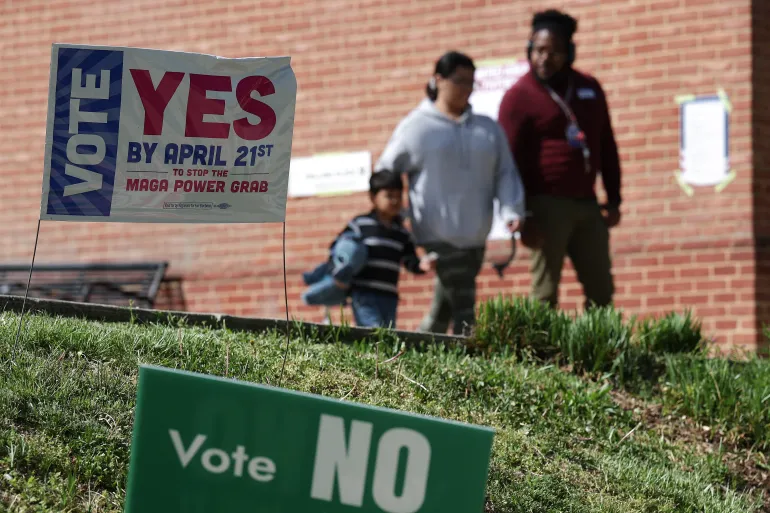




The latest front in the U.S. redistricting battle has landed in Virginia, where voters approved a new congressional map in a referendum that could ripple far beyond the state.
On the surface, the result is straightforward: Democrats gain ground in their effort to retake the House of Representatives from Republicans in the November midterms. But the mechanics behind it tell a more complicated story about how electoral rules themselves are shifting.
Redistricting is usually a once-a-decade exercise tied to the census. This cycle is different. What began as a push from President Donald Trump to redraw maps in Republican-controlled states — most notably Texas — has turned into a broader, tit-for-tat strategy across the country.
Virginia is the latest move in that chain reaction.
“Virginia’s unorthodox redistricting isn’t just a map redraw, it’s a mid-decade power play in a national arms race,” political strategist Rina Shah said.
“In a cycle defined by retaliation over reform, this sets a precedent: when one side bends the rules, the other follows, until courts or voters draw the final line.”
The numbers show how quickly that escalation has spread. Texas Republicans moved first, passing a new map in 2025 expected to add five House seats. Missouri followed with a smaller gain, while redistricting efforts in North Carolina and Ohio could yield several more Republican-leaning districts.
Democrats responded in states where they hold power. Changes in California and Utah added multiple Democratic-leaning districts, and now Virginia’s redraw is expected to bring between two and four additional seats into the party’s column.
The impact is immediate. Shah suggested the shift could transform Virginia’s delegation from a narrow split into a lopsided advantage.
“This could shift Virginia from a 6-5 split to something like 10-1 Democratic,” she said, adding it could mean “delivering up to four net seats and dramatically tightening the fight for House control in the 2026 midterms”.
That matters because control of Congress remains finely balanced. As of now, projections from Sabato’s Crystal Ball show 217 districts leaning Democratic, 205 leaning Republican and a small group still in play. In that context, even a handful of seats can change the outcome.
But the broader consequence is less about who’s ahead now and more about how the game is being played.
Samuel Wang, who leads the Princeton Gerrymandering Project, put it bluntly. Democrats may be gaining in the short term, but the process itself is eroding long-standing norms.
“But from a non-partisan good government standpoint, it’s just a terrible event,” he said.
He pointed to the scale of the shift. Mid-decade redistricting was once rare — just three instances in the past 50 years. The current cycle, by contrast, has seen multiple states redraw maps outside the usual timetable, turning what used to be an exception into something closer to a strategy.
Wang described the surge as a “complete busting of norms”.
That shift carries longer-term implications. If redistricting becomes a rolling political tool rather than a periodic adjustment, the stability of electoral maps — and the predictability of elections — could be fundamentally altered.


The latest news in your social feeds
Subscribe to our social media platforms to stay tuned