
U.S. Supreme Court’s Racial Redistricting Decision Could Shake Up Wyoming
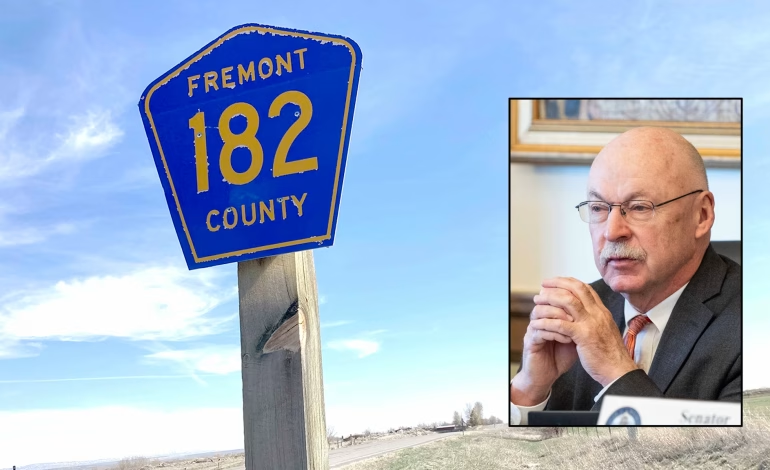

A Wednesday U.S. Supreme Court ruling declaring a race-based congressional district in Louisiana unconstitutional could have significant implications for Wyoming, where Fremont County operates a districted commission system and one legislative district was explicitly drawn to concentrate Native American voters.
In Louisiana v. Callais, the high court ruled 6-3 that a narrow, zigzag-shaped congressional district designed to create a majority of Black voters was an unconstitutional product of racial discrimination. While the court did not overturn Section 2 of the Voting Rights Act, the majority opinion by Justice Samuel Alito “updated” the legal framework, making it harder for governments to justify race-based districting. Under the new standard, governments face liability under Section 2 only when evidence supports “a strong inference that the state intentionally drew its districts to afford minority voters less opportunity because of their race.”
Justice Elena Kagan, writing the dissent, accused the majority of rewriting the law without congressional approval. “This Court has no right to cancel — sorry, ‘update’ — a duly enacted statute on the theory that it knows better,” she wrote.
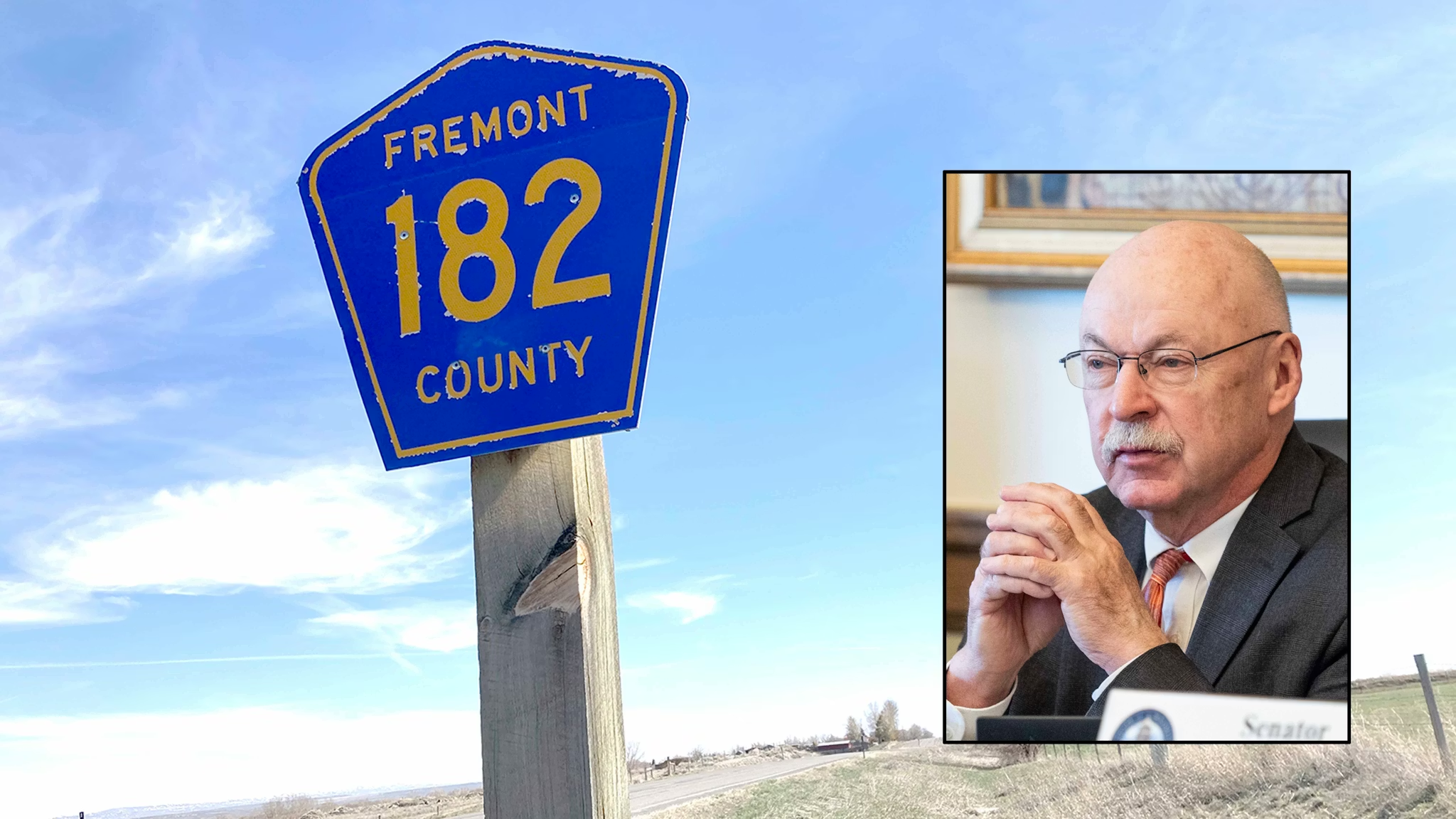
In Wyoming, the decision could directly impact Fremont County’s five-district commission system. In 2010, a federal judge ruled in favor of Northern Arapaho and Eastern Shoshone tribal members who challenged the county’s at-large elections as diluting Native American voting strength. That judge specifically noted that plaintiffs were not required to prove intentional discrimination. The Supreme Court’s new standard reverses that logic.
William Perry Pendley, who defended Fremont County’s at-large system at the time, said the ruling vindicates his position. Asked whether it could jeopardize the county’s current districted system, he replied, “the answer is yes.”
Not everyone agrees. Rep. Ken Chestek, a retired law professor, said the ruling imposes a more rigorous test but does not automatically invalidate the 2010 decision. “That doesn’t automatically invalidate Johnson’s 2010 opinion,” he said. “Even then it’s not clear … it’s very possible to me the (tribal members) would win again.”
In the Wyoming Legislature, House District 33 was redrawn in 2021 specifically to maintain a majority of Native American voters. Sen. Cale Case, who was involved in the redistricting process, acknowledged that race was a factor. “That district was drawn to have the maximum number of Native American people,” he said. He said the ruling could invite legal action, though he noted that the next redistricting is only five years away.
The majority opinion opened with a sharp statement: “Section 2 of the Voting Rights Act of 1965 … was designed to enforce the Constitution—not collide with it.” Kagan’s dissent warned the decision would render Section 2 “all but a dead letter” and predicted “far-reaching and grave” consequences. For Wyoming, those consequences are only beginning to come into focus.


The latest news in your social feeds
Subscribe to our social media platforms to stay tuned