
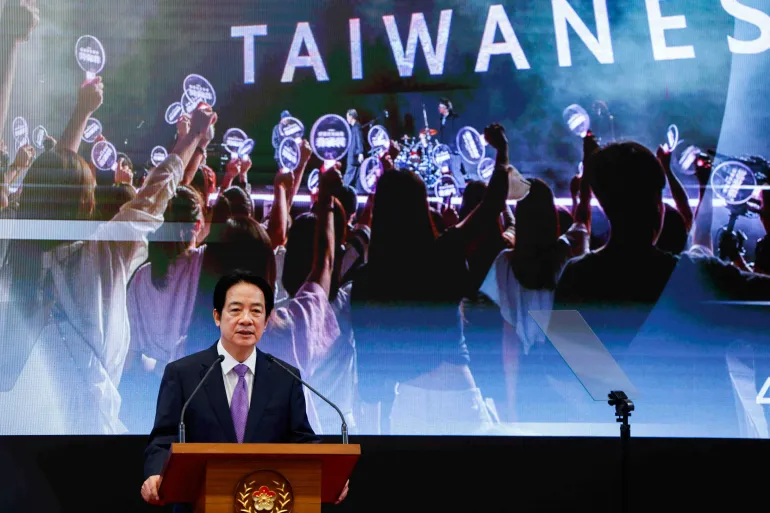



Taiwanese President William Lai Ching-te says the island’s future should be decided by its own people, not by outside powers, as pressure from both Beijing and Washington continues to shape the security debate around the Taiwan Strait.
Speaking on Wednesday, the second anniversary of his inauguration, Lai said his priority remains preserving peace and stability across the 180km waterway separating Taiwan from China. He also said his government would resist any attempt by “external forces” to change the island’s political status quo.
The message was carefully pitched: Taiwan is not seeking escalation, but it is also not willing to have its future negotiated over its head.
Lai said he remains open to engagement with Beijing, which cut off formal communication with Taipei in 2016, but only through “orderly exchanges” based on “equality and dignity”.
He also described Taiwan as a responsible member of the international community, not a “party that undermines stability” — a clear response to Beijing’s repeated accusations that Taipei is the one raising tensions.
China’s Taiwan Affairs Office rejected Lai’s remarks and accused him of inflaming the situation across the strait.
Spokesperson Zhu Fenglian said Lai was inciting “cross-strait confrontation” by supporting “Taiwan independence”. She also accused him of spreading “separatist fallacies” and using a “democracy versus authoritarianism” framing to describe relations between Taiwan and China.
Zhu further said Lai was ignoring the wellbeing of Taiwan’s public to satisfy “external forces attempting to ‘seek independence through foreign aid’ and ‘seek independence through force’.”
The exchange reflects the familiar but increasingly tense triangle around Taiwan: Taipei insists it is defending democracy and the existing status quo; Beijing says Taiwan is part of China and warns against independence; Washington remains Taiwan’s most important unofficial backer, but its signals have grown less predictable.
Lai’s first two years in office have been difficult. At home, he has faced an opposition-controlled legislature that cut his special defence budget from $40bn to $25bn. This week, lawmakers also tried and failed to impeach him over a tax revenue dispute.
His approval rating stands at 38 percent, according to a TVBS poll conducted earlier this month. That is still low, but an improvement from 32 percent during his first year in office. His disapproval rating has also fallen, from 55 percent to 44 percent.
Lai said his government would take additional steps to make up the shortfall in defence spending.
The external pressure has been just as sharp. Since Lai took office in May 2024, China has staged five rounds of military exercises around Taiwan. Beijing views the island as part of its territory and has not ruled out using force to bring it under Chinese control.
The United States, meanwhile, remains Taiwan’s key security partner, but President Donald Trump has injected fresh uncertainty into the relationship. Last week, Trump said US arms sales to Taiwan could be used as a “very good negotiating chip” with Beijing.
Those remarks followed Trump’s meeting with Chinese President Xi Jinping in Beijing, where Xi urged Washington to take a stronger stance on Taiwan’s political status.
For decades, the US has maintained strategic ambiguity over Taiwan: it does not formally recognise Taiwan as independent, but it provides arms and support intended to deter a Chinese attack.
Lai has also faced diplomatic pressure beyond the Taiwan Strait. In April, he was forced to delay a state visit to Eswatini, Taiwan’s only diplomatic ally in Africa, after several countries reportedly denied him access to their airspace under Chinese pressure. He later completed the trip by taking a longer route on King Mswati III’s private jet.

The latest news in your social feeds
Subscribe to our social media platforms to stay tuned