




EXCLUSIVE: How allies’ successes could jumpstart America’s ailing shipyards

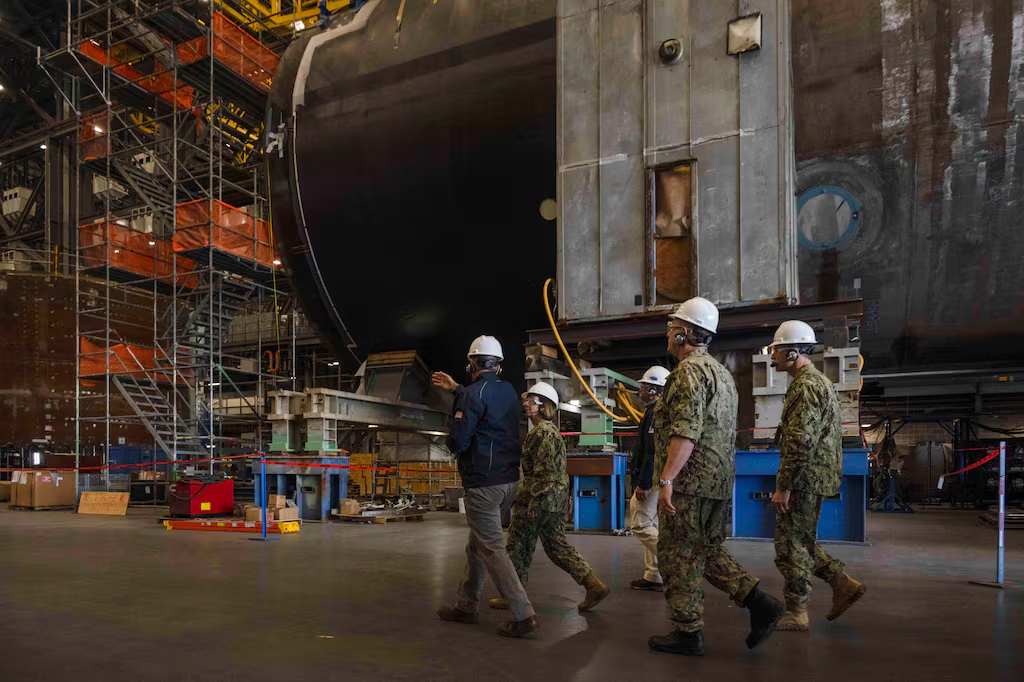
As the United States grapples with an aging fleet and a weakened maritime industrial base, a new report by the Center for Maritime Strategy (CMS) illustrates both the depth of the problem and potential remedies.
The report warns that U.S. shipbuilding capacity has been eroded by decades of deindustrialisation, inconsistent policy support, workforce attrition and reliance on global supply chains. With strategic competition at sea intensifying, these weaknesses threaten the Navy’s ability to meet fleet requirements and defend U.S. interests. The study compares five allied shipbuilding powers: South Korea, Italy, Canada, Sweden and the United Kingdom, and argues that by adopting proven international practices and investing strategically at home, the United States can rebuild its shipyards to produce ships efficiently, affordably and at scale.
In an interview with the Wyoming Star, CMS senior national security advisor Matt Reisener traced the decline to policy decisions from the 1980s onward.
“America has deprioritized shipbuilding over the past several decades,” he said.
He pointed to the elimination of subsidies in the 1980s, Congress’s difficulty passing budgets, and post-Cold War complacency.
“The rise of globalization eroded America’s industrial base, which hurt the shipbuilding industry by weakening its skilled labor pool and industrial supply chain”.
As subsidies vanished, U.S. yards struggled against heavily subsidised Asian competitors, while cost overruns and delays became the norm. The Navy’s habit of altering designs mid‑construction only compounded the problem. In his view, America still builds world‑class vessels but cannot meet demand at the speed or cost required.
The report contrasts this situation with allied efforts. Countries like South Korea and Italy, it notes, have maintained strong naval and commercial shipyards through robust government backing and early adoption of automation, artificial intelligence and digitisation. South Korea’s shipbuilding industry is “particularly strong: it is the second largest in the world,” and its companies rarely deliver late or over budget. Sweden provides a cautionary tale: it has largely ceded surface‑ship construction, focusing on submarines and managing projects for others. Britain and Canada sit somewhere between, having seen their capacity wane but investing in ambitious national shipbuilding strategies.
Reisener believes deeper unions could help the United States make up ground.
“America’s alliances can be its secret weapon in a security competition against China, but only if we’re willing to tap into them,” he said.
He outlined how agreements like AUKUS and the ICE Pact could support allied investment in U.S. shipyards and foster co‑construction of vessels to meet shared geopolitical goals. Reisener also advocates using partner ports and drydocks for maintenance, and sharing best practices to learn from allies’ successes and failures.
Not all foreign practices will translate. Reisener cautioned that South Korea’s shipyards are dominated by powerful family‑owned conglomerates, or chaebols, which can mobilise resources quickly: an industrial model the United States cannot replicate. Nevertheless, Reisener sees transferable innovations: integrating automation and digital tools, recruiting and training a new generation of naval architects and engineers, and designing ships with interoperability in mind.
“America’s allies face many of the same shipbuilding challenges we do and have taken novel approaches to trying to solve them. America should lean on that knowledge to help inform its own efforts to revitalize its maritime industrial base,” he said.
Funding is necessary but insufficient. The FY 2027 budget requests more than $60 billion for shipbuilding, the most since 1962, signalling a potential turnaround. Yet Reisener stresses that reforms must accompany spending. He urges the Navy to end mid‑stream design changes, offer incentives for on‑time delivery and make greater use of construction managers, citing the success of the National Security Multi‑Mission Vessel programme.
“Meanwhile, Congress could help address the skilled workforce shortage that has plagued the shipbuilding industry for decades by making it easier for high-skilled migrant workers from allied countries to come to America to support shipbuilding projects — something many of America’s allies have done with great success,” Reisener said.
The stakes are strategic. As the report notes, America’s diminished industrial base limits naval readiness.
“Maritime security is national security,” Reisener warned.
About one‑third of U.S. submarines are often out of service for maintenance, and more than 200 ships are set to retire by 2040. Without a revitalised shipbuilding sector, the United States could struggle to replace lost or damaged vessels quickly enough in a conflict, which an especially worrying prospect given China’s substantial shipbuilding capacity, according to Reisener.



The latest news in your social feeds
Subscribe to our social media platforms to stay tuned