




The ceasefire arrived 90 minutes before a deadline that wasn’t supposed to be met. On the morning of April 7, President Donald Trump posted that Iran’s “whole civilization will die” if the Strait of Hormuz remained closed. By nightfall, Pakistan announced a two‑week pause in hostilities. The whiplash stunned everyone, including members of Trump’s own national security team.
For forty days, the United States and Israel had pounded Iran. Operation Epic Fury, as the Pentagon called it, began with the assassination of Supreme Leader Ali Khamenei on February 28. Israeli jets struck nuclear facilities at Natanz and Isfahan. Iranian retaliation came fast and wide: more than 150 US casualties in the early stages, missiles hitting American bases across the Gulf, and a near‑complete shutdown of the Strait of Hormuz. By early April, over 3,500 Iranians were dead, including 1,600 civilians, and another 3.2 million people had been internally displaced.
The war had killed more than 2,000 people in Iran, more than 200 in Gulf countries and Israel, and at least 13 members of the US military. Israel’s parallel war with Iranian proxy Hezbollah had killed more than 2,100 people in Lebanon, ahead of a US‑brokered ceasefire that took effect on April 16. The economic toll was staggering: oil prices spiked above $100 a barrel, European gas prices jumped 28 percent in a single day, and the IMF slashed its global growth forecast to 3.1 percent. This was a war that no side was clearly winning and in which the costs were rising faster than any achievable gains.
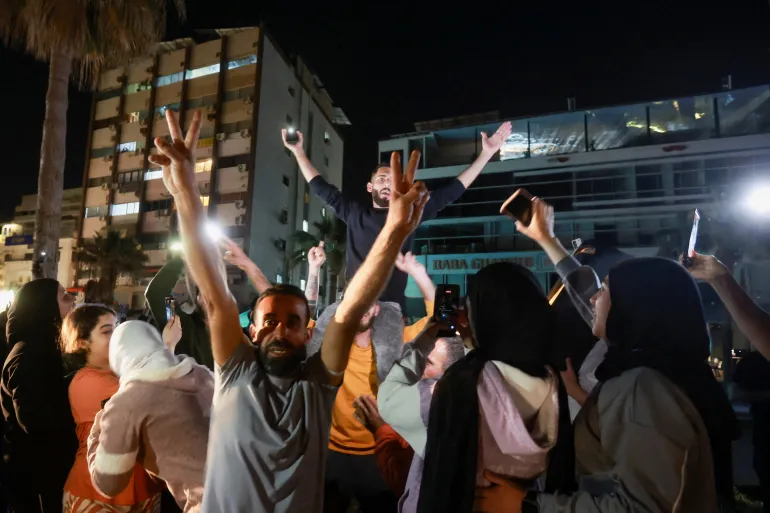
Both Washington and Tehran hailed the ceasefire as a victory. Trump called it “total and complete victory. 100 percent. No question about it.” Iran’s Supreme National Security Council said Tehran had achieved a “great victory” and “forced” the United States to accept its ten‑point plan. But the cracks appeared immediately. Netanyahu insisted the ceasefire did not apply to Israel’s operations in Lebanon. Iran insisted it did. Within hours, Israeli forces launched the largest coordinated strike of the war, hitting more than 100 sites across Lebanon in just ten minutes.
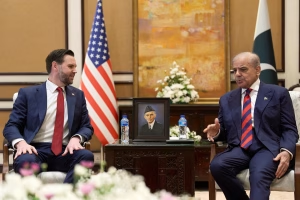
The ceasefire was already straining, however, it has held. The first round of high‑level talks in Islamabad on April 11–12 lasted more than 21 hours, marking the most significant direct engagement between the US and Iran in decades. US Vice President JD Vance led the American delegation; Iran’s Parliament Speaker Mohammad Bagher Ghalibaf led Tehran’s team. The session ended without an agreement. Vance claimed Iran chose “not to accept our terms,” adding that the US needs to see a “fundamental commitment” from Tehran not to develop nuclear weapons. Ghalibaf said the opposing side “ultimately failed to gain the trust of the Iranian delegation.”
The sticking points are very familiar. Iran’s nuclear program remains the central obstacle – specifically, the fate of its stockpile of highly enriched uranium and the duration of any halt to enrichment work. Iran has demanded a complete end to all sanctions and the withdrawal of US combat forces from the region. It has also insisted that any ceasefire must extend to Lebanon, viewing the conflict there as part of the same confrontation. The US has rejected that linkage.
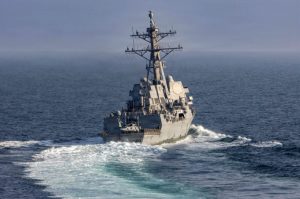
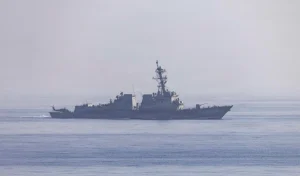
When talks collapsed, Trump moved to escalate economic pressure. On April 13, the US Navy began enforcing a blockade of all ships entering or leaving Iranian ports via the Strait of Hormuz. The blockade, announced with a notice to mariners, covers “the entirety of the Iranian coastline … not limited to ports and oil terminals.” Any vessel entering or departing the blockaded area without authorization is subject to interception, diversion, and capture. US officials said the goal was to strip Iran of the leverage it had gained from controlling the waterway. If successful, the blockade would sever Iran’s nearly 2 million barrel‑per‑day oil export trade – its main source of hard currency – and force Tehran back to the negotiating table.
The blockade carries its own risks. Iran has threatened to shut down Red Sea trade unless Washington lifts the blockade, and Tehran’s military has warned that it could interpret the blockade as a belligerent act, ending the fragile ceasefire. Maritime law experts warned that the blockade risks crossing into disputed territory under international law and that enforcement would be costly and difficult.
Despite the deadlock, shuttle diplomacy has intensified. Pakistan’s Prime Minister Shehbaz Sharif is on a four‑day regional tour, visiting Saudi Arabia, Qatar, and Turkey to shore up support for the process. Pakistan’s powerful army chief, Field Marshal Asim Munir, traveled to Tehran bearing a new message from Washington. Iran’s ambassador to Pakistan said Tehran would not consider any venue other than Pakistan for talks with Washington. White House Press Secretary Karoline Leavitt said a second round of negotiations “is very likely” to be held in Islamabad, adding that the White House feels “positive about the possibility of an agreement.”
On April 16, a significant breakthrough emerged on a separate track. Trump announced that Israel and Lebanon had agreed to a 10‑day ceasefire, starting that evening at 5 p.m. EST. Trump said he had spoken with Israeli Prime Minister Benjamin Netanyahu and Lebanese President Joseph Aoun and that the two leaders had agreed to formally begin a ceasefire “in order to achieve PEACE between their countries.” Lebanon’s President Aoun thanked Trump for his “efforts” to secure the truce. Iran’s parliamentary speaker, Mohammad Bagher Ghalibaf, told his Lebanese counterpart that a ceasefire in Lebanon was “as important” as in Iran.
The Lebanon ceasefire is also limited and fragile. Israel has vowed to keep its forces in southern Lebanon and said it will attack if threatened by Hezbollah. Hezbollah has not publicly committed to the truce, and its lawmakers have said everything depends on Israel halting all forms of hostilities. The Lebanese Army said early on April 17 that Israel had committed violations of the ceasefire, including the intermittent shelling of several southern Lebanese villages. Yet the truce has been welcomed as a necessary step. Iran’s Foreign Ministry said the ceasefire was “a positive signal” for a second round of negotiations with the United States.
Right next to the realm of politics is the economic dimension. Iran effectively closed the Strait of Hormuz in early March, stranding hundreds of oil and gas tankers and disrupting global oil markets. The US responded with its own naval blockade of Iranian ports. The question now is which country can better withstand the economic pain.
The numbers are stark. Analysts estimate the US blockade could cost Iran $435 million a day in lost oil and petrochemical exports – roughly $13 billion per month. Iran exports about 1.5 million barrels of oil per day, and more than 90 percent of that oil transits through Kharg Island in the Persian Gulf. If all of Iran’s crude exports by ship are halted, the country’s limited storage capacity means it could be forced to shut down oil production in as few as two weeks. The blockade would also disrupt imports of food and industrial products, triggering inflation and currency pressure.
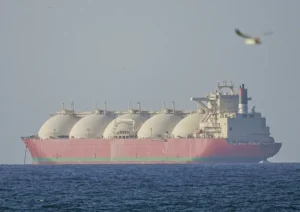
Yet Iran retains its own economic weapon. By keeping the Strait of Hormuz largely closed, Tehran has choked off a fifth of the world’s seaborne oil trade. Oil prices have remained elevated – Brent crude was trading near $96 a barrel as of early morning April 17, still significantly above pre‑war levels of around $65. The disruption has affected not just oil but also aluminum, helium, fertilizer, and other critical goods that transit the Gulf.
The IMF has warned that the global economy is at risk of recession if the war persists. Its most optimistic “reference scenario” assumes a short‑lived war and forecasts 3.1 percent real GDP growth for 2026 – down 0.2 percentage point from its previous forecast. Under an adverse scenario, oil prices would rise by 80 percent starting in the second quarter of 2026, pushing several countries into outright recessions.
For the United States, the economic impact has been mixed. As the world’s largest oil producer, the US is less exposed than many other developed economies. Gas prices have risen above $4 per gallon on average, and inflation spiked to 3.3 percent in March from 2.4 percent in February.
The blockade has also tested US resolve. Trump acknowledged in an interview that gas prices could be “the same or maybe a little bit higher” by the midterm elections. Rising oil prices hit consumers directly, increasing non‑discretionary spending on fuel and heating. As a result, consumers cut back on the discretionary spending that small businesses rely on, reducing cash flow and financial health. Small businesses have become all too adept at managing through crises, but the uncertainty caused by the sudden spike in oil prices has caused many to retrench, holding off on new projects, new hires, and growth investments.
Ellen R. Wald, President of Transversal Consulting and Senior Fellow at the Atlantic Council’s Global Energy Center, an energy analyst and president of Transversal Consulting, the author of ‘Saudi, Inc.,‘ put the situation in perspective:
“This blockade was necessary to prevent Iran from utilizing the Strait of Hormuz for its own oil trade while simultaneously denying other countries access. No Iranian ships have been able to leave or enter the Persian Gulf, which is a significant change from pre-blockade. Oil futures prices may be in the $90s, but the price that customers are paying for actual oil is significantly higher. For example, Asian customers are being charged prices in Arab Light that are over $120/barrel. European customers are seeing even higher prices. The prices are not especially challenging for the US but are significantly challenging for South Korea and Japan. In addition, they must use longer, more circuitous routes to buy Saudi Oil from the Mediterranean since the Persian Gulf is inaccessible.”
More in-depth analysis by Dr. Wald can be found here.
Ben Johnston, COO of Kapitus, a small business lender and marketplace, outlined the cascading effects:
“The war with Iran has effectively closed the Strait of Hormuz and forced producers in the Gulf region to begin shutting down oil and gas production, actions that cannot be quickly reversed. Given that approximately 20% of the world’s oil production must travel through the Strait of Hormuz in order to reach consumers, it is likely that this disruption will be significant and last for months, depending on the duration of hostilities and the time it takes to reestablish production and a working supply chain once the war is over. Rising oil prices are yet another shock to operating margins that small businesses need to contend with (on top of inflation, tariffs, etc.). Today, with oil climbing, small businesses are once again grappling with the impact of an unforeseen expense and agonizing over whether to pass these increased costs on to an already stretched customer base.”
Johnston added that the uncertainty will likely cause many small businesses to retrench, holding off on new projects and new hires:
“Given the importance of small businesses to the US economy, this could have a significantly negative impact on the unemployment rate and overall GDP growth.”
On the positive side, the US oil and gas industry stands to benefit. Higher prices make additional extraction projects economically viable. And because the US is the world’s largest oil producer, it is less exposed to economic disruption than Europe or Asia.
“If US oil prices become a relative advantage to US businesses, it may serve to speed the repatriation of manufacturing back to the US during this period of instability,” Johnston noted.
Johnston’s comment can be found in full here.
So the ceasefire has bought time, but no resolve for the underlying conflict. The core issues remain as intractable as ever. Iran insists on maintaining its nuclear enrichment program, its control over the Strait of Hormuz, and its network of regional allies. The US demands that Iran renounce nuclear weapons, accept strict inspections, and end its support for militant groups. Israel wants Hezbollah dismantled and Iran’s military capabilities degraded. These are not positions that lend themselves to a quick compromise.
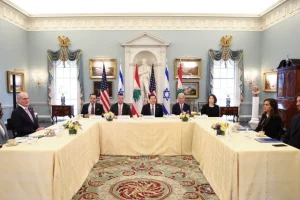
Yet there are reasons for cautious optimism. The Lebanon ceasefire, however fragile, addresses Iran’s core demand that the truce extend to all fronts. Trump has said negotiations with Iran could resume “over the weekend” and that a deal is “very close.” Iran’s ambassador to the UN said Tehran remains “cautiously optimistic” about the negotiations. And both sides have signaled that they are willing to extend the ceasefire beyond its April 22 expiration to allow for further diplomacy.
Trita Parsi, writer, analyst, Co-Founder and Executive Vice President of the Quincy Institute for Responsible Statecraft, argues that the recent ceasefire has shifted leverage back toward the US, giving President Trump a way out of a war he was ill-advised to start. Before the pause, Trump was cornered by rising gas prices and a barren escalation ladder, and he needed Iran’s permission to disengage. The ceasefire has altered this equation by allowing Trump to step back without Tehran’s formal approval, even though Iran will likely maintain control of the Strait of Hormuz.
Ahmad Kazemi, Professor of International Law in Tehran, Senior Researcher on Eurasian Issues, and senior author and researcher in the field of the Caucasus and Eurasia, focused on the unclear US position:
“Paragraph 3, Article 3 of the UN Definition of Aggression considers the naval, land, or air blockade of a country a war crime. Therefore, the continuation of the naval blockade of Iran by the United States is, legally speaking, a clear violation of the ceasefire agreement.The continuation of the blockade will not yield any military, political, or economic advantage for Donald Trump. Rather, it increases the likelihood of the ceasefire ending sooner than the specified deadline and of retaliatory actions by Iran in the Strait of Hormuz and Bab el-Mandeb in the Red Sea. As a result, it will make the continuation of negotiations very difficult… The naval blockade of Iran in the Persian Gulf will not cause Tehran to back down; because not only did Iran demonstrate its military capability during the war to strike Israel and US bases in the region and to prolong the war, but also, under the influence of this war, national unity in Iran has reached an unprecedented level in the last five decades… According to the initial agreement between Iran and the US before the start of the Islamabad talks, the ceasefire was supposed to be established on all fronts of the conflict, including Lebanon. Israel’s goal in continuing its attacks on Lebanon is to eliminate any possibility of an agreement between the US and Iran in the coming days. Israel has been the single most important obstacle to an agreement between Iran and the US in the last 48 years.From Iran’s perspective, the Axis of Resistance is a unified front. Therefore, if Israel’s aggressions against Lebanon continue and the naval blockade of Iran persists, the likelihood of the resumption of war in the coming days, despite the efforts of mediators, will intensify. …Unfortunately, with Netanyahu’s influence in the White House, the thoughts and decisions of the US President are surrounded by a pro-Israel team and the Epstein faction, and Trump has become the executor of the “Israel First” policy. For this reason, in Trump’s fluctuating positions and contradictory statements, only one thing remains constant: his unconditional support for Netanyahu, who has been accused of war crimes by the International Criminal Court. For this reason, there is pessimism in Iran regarding Trump’s adherence to the ceasefire.”
Dr. Kazemi’s comment can be found in full here.
Bilal Hyder Simair, an Islamabad-based independent researcher, writer, and focused on West Asia’s strategic, political, and security affairs, including Major Power Politics and South Asian Affairs, offered a more balanced assessment. He noted that the effective smart control of the Strait of Hormuz and continued defensive strikes despite heavy bombardment have proven Iran’s capabilities to continue this slow, deadly, and devastating defensive war against Israel and the USA for months to come.
“The USA failed in the pre‑planning of the war. It had only a few initial successes where it targeted and assassinated top leadership, but again, due to a lack of understanding of the Iranian institutional structure and the Red Shiism ideology, it couldn’t achieve its targets of government change in Iran or the destruction of its military power. Iran can not and will not blindly trust the peace talks held in Islamabad, however, Iran does understand the need for a complete ceasefire and is willing to do so but on its conditions, including control over the Strait of Hormuz, a complete end to the current war and future aggression, and the ceasefire in Lebanon. The US is forced into negotiations, as it and Israel failed badly in strategically defeating Iran. In post-war conflict, Iran will be an internationally recognized major power with enough capabilities to defend and counterattack any world major power. The USA and Israel have the world’s best weapons, technology, and a huge network of radars, military bases, and assets in the entire West Asia, and despite all this, they could not neutralize Iran’s military capabilities, and also couldn’t open the Strait of Hormuz with all their naval assets. This war has proven how fragile these assets can be if employed in a war zone far away from home, and the main reason for their manufacturing in the first place was to project US power abroad, and Iran shattered its might in a matter of a week’s time when all naval assets were forced to stay hundreds of kilometers away, and the USA even couldn’t provide military cover to ships as claimed by the US, which again shows no use of these ships in such conflict.
At the end, these peace talks are necessary for both, and I think a suitable outcome will be achieved in the near future, as the USA cannot continue with the international market at risk of collapsing, and Iran also needs an end and economic relief to rebuild and regain its strength despite having enough resources to continue the war for months to come.”
Simair’s comment can be found in full here.
Yassamine Mather, editor of the Academic Journal Critique and a senior researcher at the University of Oxford, focused on the nuclear impasse:
“The recent talks were doomed by a fundamental disagreement on the goal: the US wants a total Iranian surrender on nuclear enrichment, while Iran views enrichment as a non-negotiable pillar of national legitimacy and deterrence. Both sides use diplomacy as a breathing space to regroup for the next round of escalation. When it comes to ‘uranium enrichment’ no Iranian faction – hardline or moderate – can afford to “return home” having agreed to a total halt without looking like they’ve surrendered the nation’s sovereignty. However, as far as I can tell, reducing the level of enrichment, a pause of up to 5 years, is negotiable; that still leaves the issue of current reserves of enriched uranium. The Iranian delegation has in the past signaled willingness to move these to a country of their choice. It looks like the US wants to decide where. While the West focuses on centrifuges, Tehran views its control over the Strait of Hormuz as its most effective weapon. Iran has discovered that the ability to choke global energy routes provides more immediate leverage than a hypothetical bomb. Deterrence isn’t just about one weapon; it’s a mix of geography, regional alliances, and the capacity to inflict global economic pain. Trump’s approach pivoted sharply from bizarre proposals to aggressive economic warfare. Previously, he had floated ideas like “joint control” of the Strait (with the US and Iran charging tolls). When talks failed, the US immediately escalated to a blockade of Iranian ports. This wasn’t a minor tweak in policy; it was a move intended to sever Iran’s economic lifelines. Though initially framed in wider terms around Hormuz, it was later narrowed toward Iranian-linked shipping. Even so, the implications remain enormous. Such a move risks turning a fragile ceasefire into a prolonged naval confrontation with global consequences. True, two days into the blockade it might have looked like another empty gesture. After all, the Chinese tanker Rich Starry, carrying 250,000 barrels of methanol, sailed past the US Navy … but only to U-turn. It would appear that Donald Trump starred down Xi Jinping. What started as a threat turned into a high-stakes standoff involving global players like China. China is now encouraging Iran to return to negotiations, and there is new Pakistani mediation.”
The coming days will be critical. The primary goal for both sides appears to have shifted from a comprehensive peace agreement to a more modest interim deal that could extend the truce and prevent an immediate return to conflict. Iran has reportedly offered to allow ships to sail freely through the Omani side of the Strait of Hormuz without risk of attack, provided a durable deal is clinched. The US has deployed another 6,000 troops to the Middle East, bringing the total regional presence to around 50,000, in a clear signal of military pressure should diplomacy fail.
Trump has warned that if there is no deal, fighting resumes. Iran has said it is ready to fight if negotiations fail. The clock is ticking. April 22 is coming.


The latest news in your social feeds
Subscribe to our social media platforms to stay tuned