

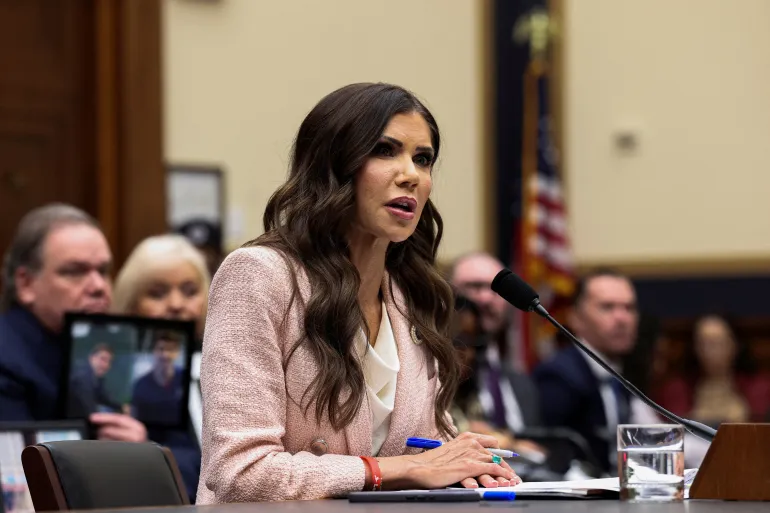


A relatively small theft case in Washington has taken on a larger political role after a federal court sentenced a Chilean national to three years in prison for stealing a handbag belonging to former Homeland Security Secretary Kristi Noem.
Mario Bustamante Leiva, 50, will also face deportation after serving his sentence, the Trump administration said on Wednesday, framing the outcome as part of a broader message on crime and immigration enforcement.
“Bustamante Leiva came to Washington illegally to prey on citizens of the District. He methodically targeted women at restaurants, stealing their purses, and monetizing the stolen cards within minutes,” US Attorney Jeanine Pirro said in a statement.
“His pattern of theft ends here. He will serve his prison term and be deported.”
The case itself dates back to April 2025, when prosecutors say Bustamante Leiva and an accomplice carried out a series of thefts in the capital. Surveillance footage showed a pattern: identifying targets in public places, taking purses, and quickly using stolen credit cards to purchase gift cards.
One of those incidents involved Noem, who was dining with her family when the theft occurred — despite being under Secret Service protection at the time. The breach raised immediate questions about security protocols surrounding senior officials.
“Surveillance cameras recorded Bustamente Leiva repeatedly looking down toward Noem’s purse before bending down and snatching it,” a statement from the US Justice Department reads. “Noem’s purse contained several credit cards and about $3,000 in cash.”
Bustamante Leiva was charged with multiple counts, including three counts of wire fraud and one count of first-degree theft. His co-defendant, Cristian Montecino-Sanzana, received a shorter sentence of 13 months in prison and three years of supervised release, but also faces deportation.
Beyond the courtroom, the case has been folded into a wider narrative by the Trump administration. Officials have pointed to it as evidence supporting stricter immigration enforcement and a more aggressive federal role in tackling crime in Washington.
That broader effort has already reshaped the city’s security landscape. Last August, Trump ordered thousands of National Guard troops into the capital, citing what he described as a “crime emergency,” even as official data showed violent crime at a 30-year low.
“Citizens, tourists, and staff alike are unable to live peacefully in the Nation’s capital, which is under siege from violent crime,” Trump wrote in an executive order on August 11.
The deployment remains partially in place, with roughly 2,500 troops still supporting local law enforcement, though their role is limited. Federal law restricts military involvement in civilian policing, meaning troops cannot make arrests.
Meanwhile, the figure at the center of the original incident has since moved on. Noem was dismissed as Homeland Security secretary on March 5 amid scrutiny over spending and her approach to immigration enforcement. She has since been reassigned to the Shield of the Americas initiative, a programme aimed at strengthening regional security ties in Latin America.

The latest news in your social feeds
Subscribe to our social media platforms to stay tuned