



Australia, Japan seal $7bn warship deal as defence ties deepen
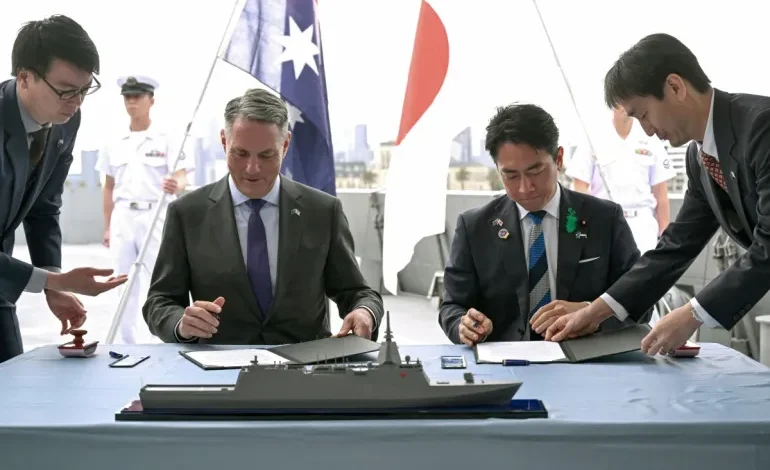

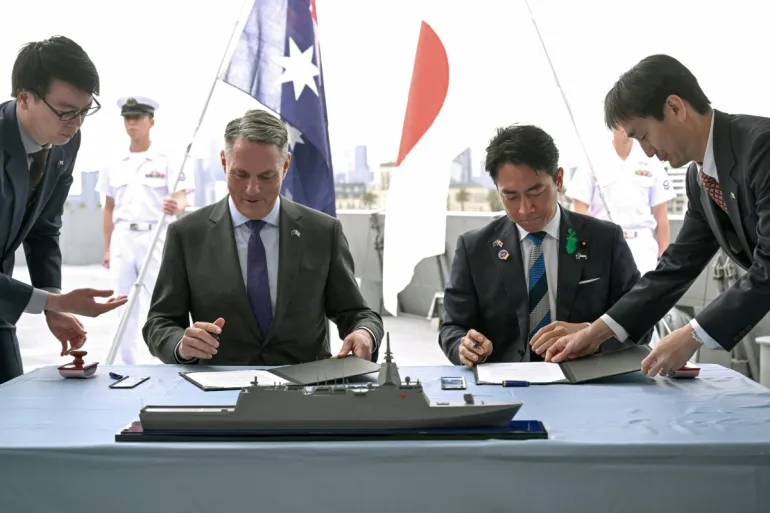
Australia and Japan have taken another step toward closer military alignment, signing contracts for the first three warships under a $7bn defence agreement that reflects a broader shift in regional security thinking.
The deal, announced on Saturday in Melbourne by Australia’s Defence Minister Richard Marles and Japan’s Defence Minister Koizumi Shinjiro, centres on the construction of Mogami-class stealth frigates — a platform increasingly seen as critical for modern naval operations.
Under the arrangement, Japan’s Mitsubishi Heavy Industries will build three vessels in Nagasaki, while Australian firm Austal will construct eight more in Western Australia. The first Japanese-built ship is expected to be delivered in 2029 and enter service the following year.
Beyond the ships themselves, the agreement — referred to as the “Mogami Memorandum” — signals a deeper layer of cooperation. Both sides have committed to expanding “closer industrial cooperation” in defence, pointing to a model that blends procurement with long-term capability sharing.
For Canberra, the move fits into a broader recalibration of naval priorities.
“Our surface fleet is more important than at any time in decades,” Marles said. “These general-purpose frigates will help secure our maritime trade routes and northern approaches as part of a larger and more lethal surface combatant fleet.”
Tokyo is framing the partnership in similar terms, but with an emphasis on the wider strategic environment. Shinjiro said the need for coordination is growing as both countries face an “increasingly severe security environment”.
The deal follows Australia’s decision last year to select Mitsubishi Heavy Industries over Germany’s Thyssenkrupp after a competitive bidding process — a choice that underscores how defence partnerships are increasingly shaped by geopolitical alignment as much as technical capability.
It also sits within a larger expansion of Australia’s military spending. Canberra has committed to $305bn in defence investment over the next decade, aiming to rebuild naval capacity to levels not seen since World War II. Defence spending is projected to rise to 3 percent of GDP by 2033, marking a significant shift in budget priorities.
At the regional level, the agreement reflects how alliances are tightening across the Asia-Pacific. Australia and Japan, both close US allies, have been steadily increasing military cooperation, driven in part by concerns over shifts in the balance of power and China’s growing influence.
Their cooperation also extends into multilateral frameworks, including the Quad, alongside the United States and India — a grouping that has become a focal point for security coordination in the region.



The latest news in your social feeds
Subscribe to our social media platforms to stay tuned